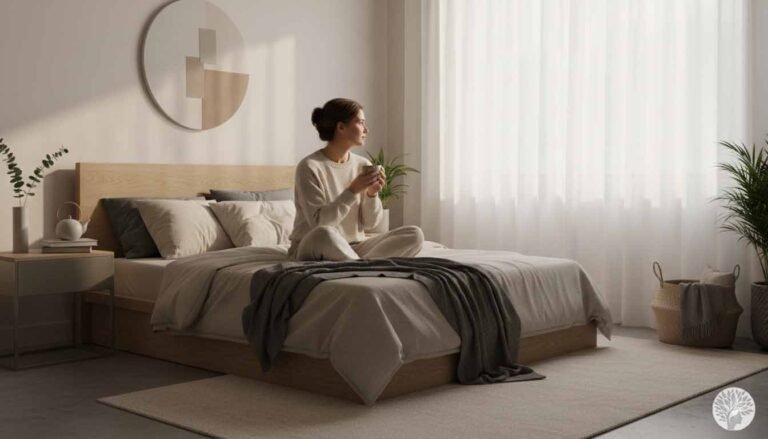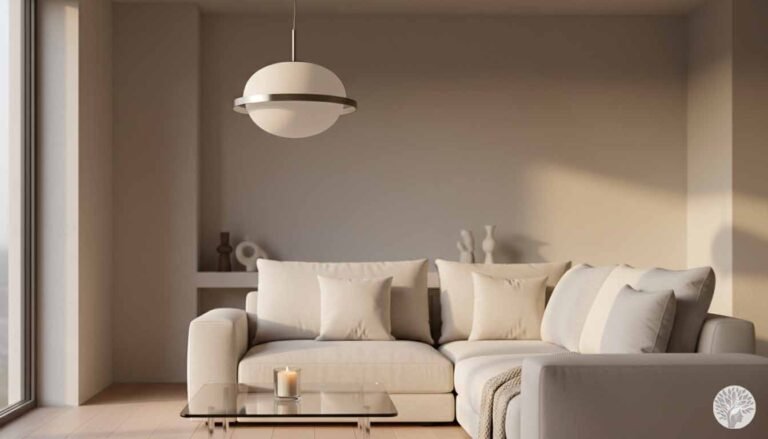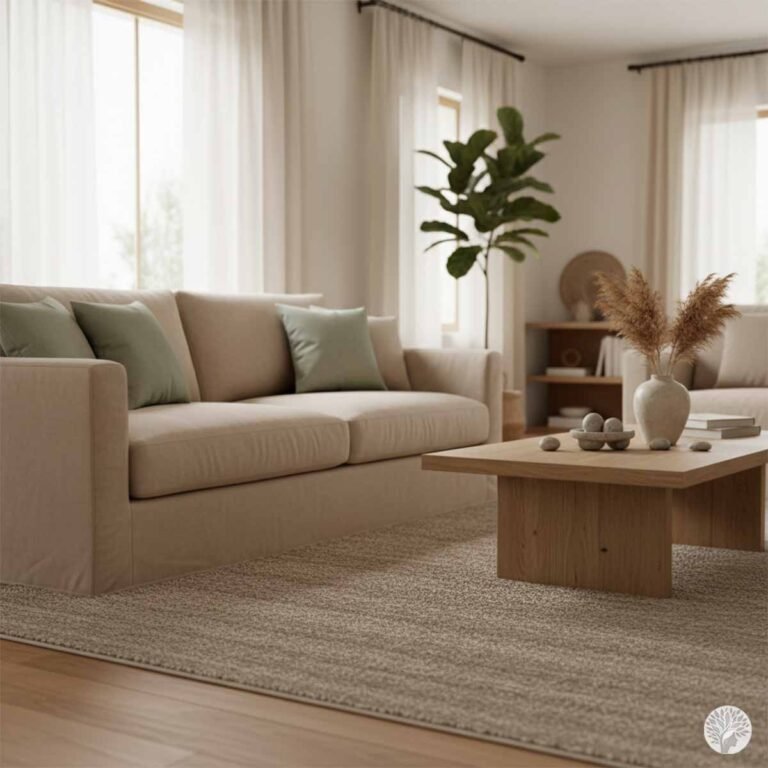
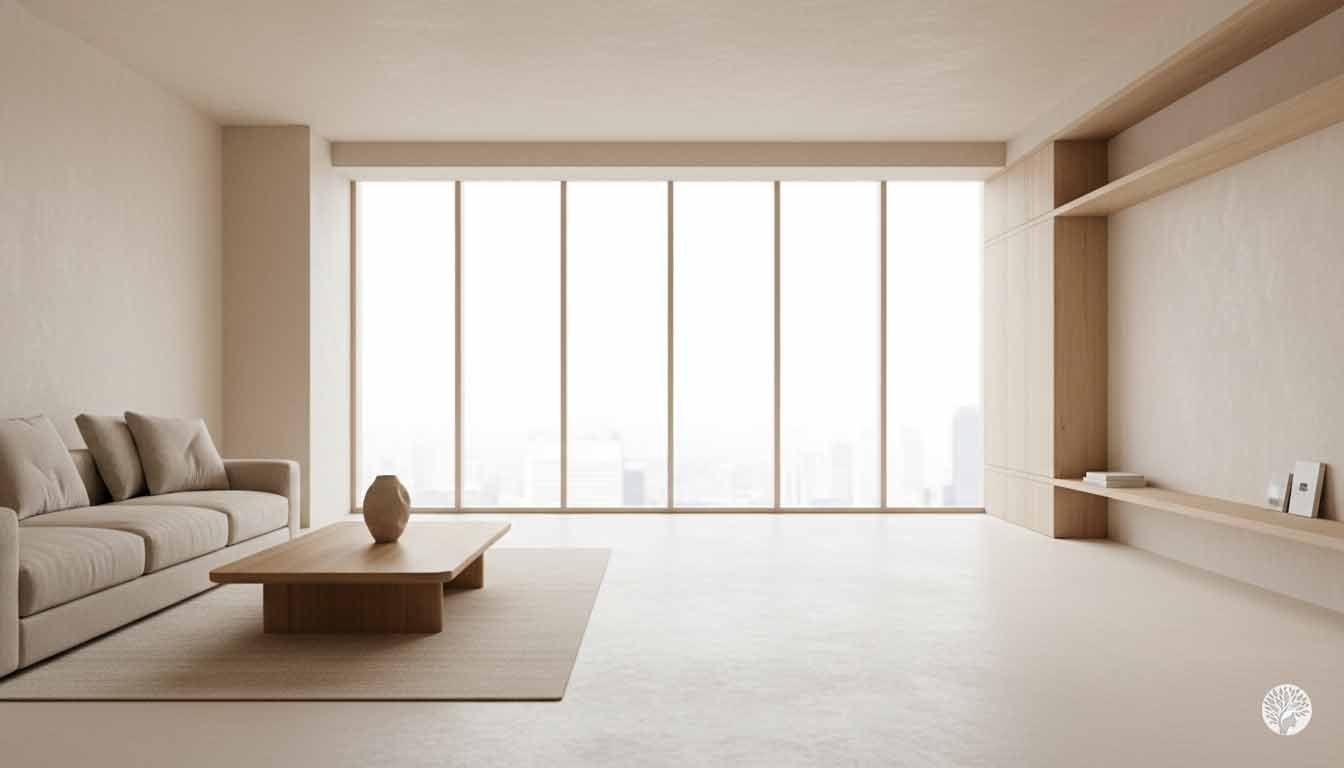

Breathable Home Design is the intentional use of negative space, visual silence, and simple layouts to reduce cognitive load, support nervous system regulation, and create a home environment that feels calm, open, and easy to live in.
Hey Beautiful!
Have you ever walked into a room and felt your shoulders immediately rise toward your ears? It’s a subtle, creeping tension, a tightening in your chest or a shallowing of your breath. The room might not be “messy” in the traditional sense; there are no toys on the floor or dishes in the sink. And yet, the space feels… heavy.
You don’t know what’s wrong. But your body does.
In many modern homes, we are taught that “more is more.” We fill our walls with gallery displays of thirty different frames, cover our coffee tables in layers of intricate decor, and pack our bookshelves until every square inch of vertical space is screaming for attention. To the eye, there is no “end.” There is no perimeter to the chaos.
When you enter a space like this, your brain enters a state of continuous processing. Because there is no clear place for your gaze to land and simply stop, your eyes continue to skip from object to object, texture to texture, and color to color. This is what neurologists call High Cognitive Load. Even if you aren’t consciously thinking about the items in the room, your brain is working overtime to categorize, filter, and ignore them. Your brain never stops scanning.
The Nervous System on High Alert
This is the exact opposite of a Breathable Home Design.
When our environment is saturated with this kind of relentless visual input, our nervous system stays on high alert. Your amygdala, the part of the brain that scans for threats perceives “clutter” as a series of unfinished tasks or potential obstacles. This keeps you in a state of low-level “fight or flight” all day long. You might find yourself snapping at the children or feeling a sudden burst of irritation, and you won’t realize it’s because your living room is technically “screaming” at you.
Today, we are moving beyond the daily surface-level routine and into the very bones of your home. We are looking at the architecture of your peace. We aren’t just decorating for a magazine cover; we are learning how to design a space that doesn’t just look good, but a space that actually lets your soul breathe.
By introducing Negative Space, we aren’t losing style, we are gaining air. We are creating a home that acts as a physical exhale, allowing your nervous system to finally drop from a state of “High Alert” back into your Window of Tolerance.
The Concept of a “Visual Exhale”
In the world of high-end interior design, we talk a lot about Negative Space. Architecturally, it’s defined as the area around and between the subjects of an image or a room. But for a mother, negative space is something far more profound: it is a boundary for the mind.
Usually, when we look at an empty corner, a bare wall, or an expansive countertop, our first instinct is to “fix” it. We think, “What can I put there? A lamp? A basket? Another framed photo?” We have been conditioned to believe that an empty space is an unfinished space.
But in a Mindful Home, we flip that script. We see that empty space as a Visual Exhale.
Think about the physical sensation of a deep, cleansing breath. When you exhale, you are releasing pressure; you are letting go of what you no longer need. A clear wall or a bare surface does the exact same thing for your brain. It tells your nervous system: there is nothing to do here. There is no task to complete, no object to clean, and no “mental tab” to process.
The Silence Between the Notes
Negative space is not “wasted space.” It is the silence between the notes that makes the music beautiful. Without the pause, the symphony is just noise. Your home is the same. If every inch is filled with “sound” patterns, objects, colors, your life becomes a relentless wall of noise. By intentionally leaving a surface clear or a wall bare, you are giving your brain permission to rest. You are creating a “Soft Landing”, a place where your eyes can fall and simply be still.
This stillness is what allows the items you do choose to keep to truly shine. When you have one beautiful vase on a large, clear table, that vase becomes an anchor of beauty. When that same vase is surrounded by five other knick-knacks, it becomes just more “Visual Static.”
Understanding the Difference
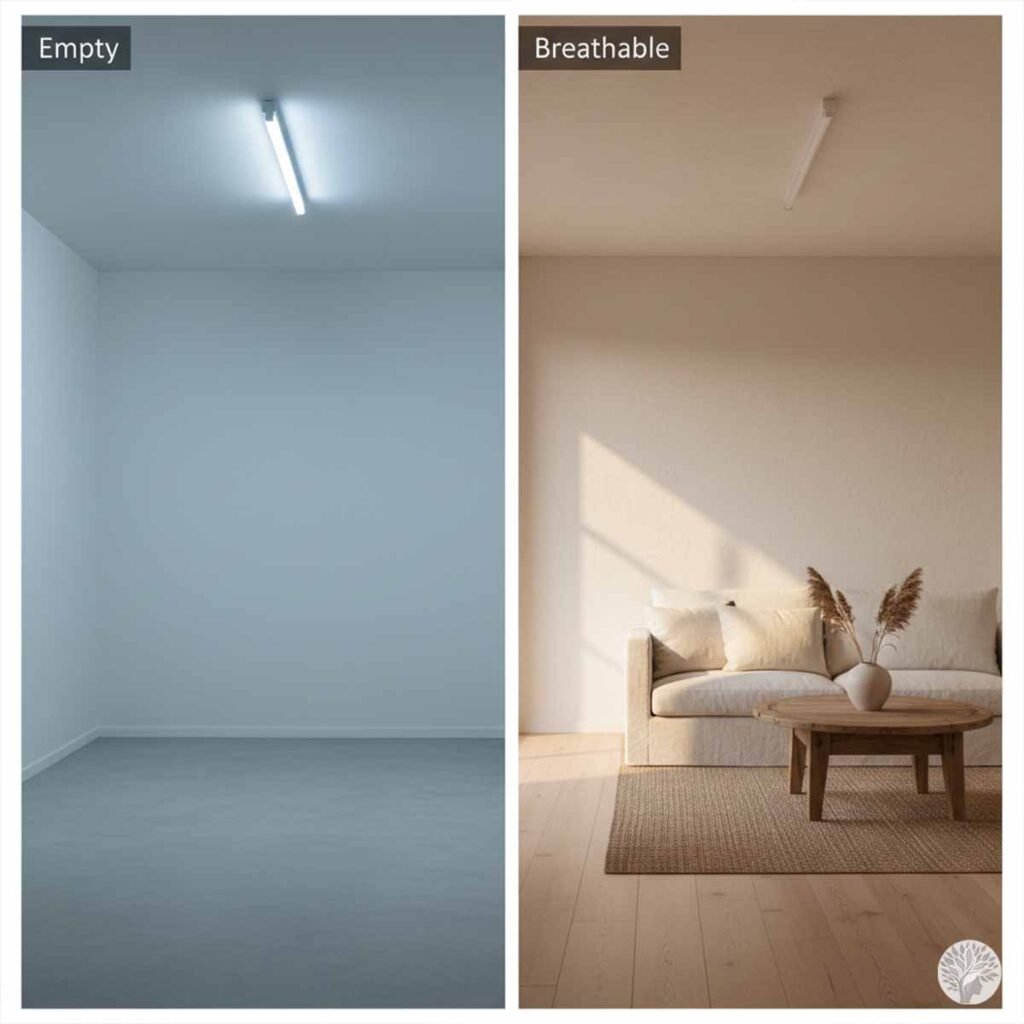
It is important to distinguish between a home that is “empty” and a home that is “breathable,” as they sit on opposite ends of the emotional spectrum:
- Empty feels cold, sterile, and unlived-in. It feels like a house that has been staged for sale but lacks the soul of a family. It can actually trigger a different kind of anxiety, a feeling of lack or isolation.
- Breathable feels intentional, warm, and restorative. It feels like a sanctuary that has been curated to protect the people inside it. A breathable home doesn’t feel “unfinished”; it feels resolved. It’s a space where you can feel the air moving, where the light can stretch across the floor, and where your mind can finally land softly after a long day of “doing.”
By protecting these pockets of negative space, you aren’t just decorating; you are building a psychological buffer between yourself and the demands of the outside world.
The 70/30 Rule: Your Practical Blueprint
If you want to know how to achieve a high-end, breathable look without adopting the “all-white, all-empty” lifestyle of a strict minimalist, you need a quantifiable boundary. I call this the 70/30 Rule. This is more than a design guideline; it is the simplest, most effective way to protect your nervous system from chronic sensory overload.
In a home that feels “heavy,” the ratio is usually flipped. We often have 90% of our surfaces covered with “functional” items, leaving only 10% of the surface visible. This forces the brain into a state of constant Visual Scanning. When you walk into a room, your eyes are darting from the toaster to the mail pile to the half-empty coffee mug. Each of those items represents a “mental tab” that remains open.
The Rule: Aim for 70% clear surface and 30% intentional decor.
When you commit to this ratio, you are essentially creating a “Visual Buffer.” You are telling your brain exactly where the work ends and where the rest begins. This rule applies to every horizontal plane in your home, the places where “Visual Static” tends to accumulate most.
Applying the Rule to Your Anchor Surfaces
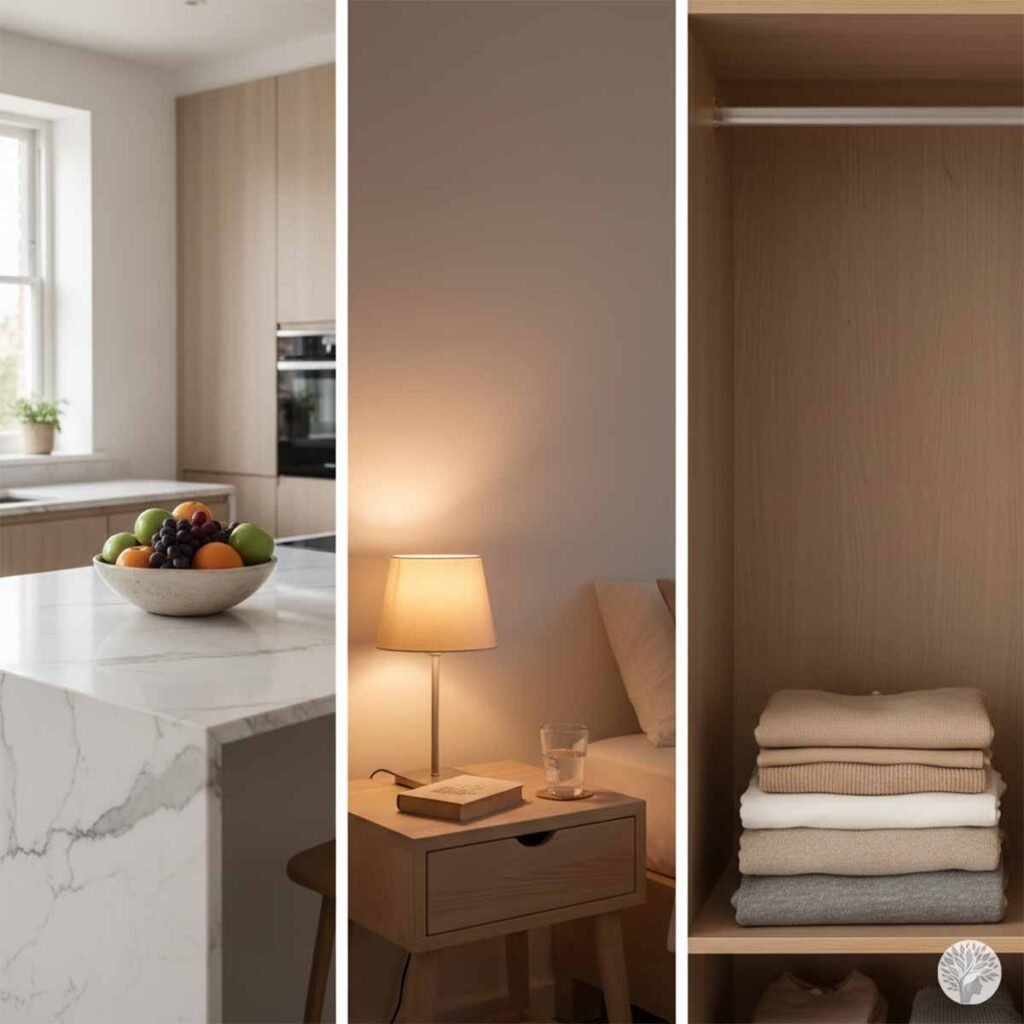
- The Kitchen Island: As the command center of the home, the island is often the first victim of clutter. Instead of a toaster, a stack of school papers, a charging station, and a fruit bowl, choose the fruit bowl as your 30%. Let the rest of the stone “breathe.” When you look across that 70% of clear, reflective surface, your brain registers “Task Complete” rather than “More Work.”
- The Nightstand: This is the most influential surface in your home because it is the last thing you see before sleep and the first thing you see upon waking. It should not hold ten items. Keep three perhaps a lamp, a current book, and a glass of water. By protecting 70% of that small surface, you are creating a Pocket of Peace in the very moments your brain is trying to enter a state of deep rest.
- The Wardrobe Shelf: We often focus only on horizontal space, but vertical “clutter” is just as heavy. Don’t stack your sweaters or bins to the ceiling. Leave the top 30% of the vertical shelf space open. This prevents that “crushing” feeling when you get dressed in the morning, allowing you to start your day in a state of expansion rather than restriction.
The Biological Result
When your eyes sweep across a room and hit that 70% of “nothing,” something remarkable happens to your physiology: your heart rate naturally slows down.
This is because “nothing” requires no processing power. In that 70% of clear space, your gaze can glide. There is no obstacle for the eye to jump over, no task to remind you of your to-do list. This is where the Visual Exhale becomes a physical reality. You are creating a home that literally lowers your baseline cortisol levels just by existing within its walls.
Texture Over Clutter
You Don't Need More Things, You Need Better Surfaces
One of the biggest fears mothers have when they hear the word “minimalist” or “breathable” is that their home will begin to feel like a sterile hospital wing. They worry that by removing the layers of “stuff,” they are removing the soul of their home.
But the secret to a space that feels both expansive and incredibly cozy is Tactile Texture.
When a room feels empty in a “bad” way, it’s usually because the few things left are cold, flat, or synthetic. To create a home that breathes, you don’t need more items; you need better surfaces. You are trading quantity for a sensory depth that grounds your nervous system.
The Psychology of Materiality
Our brains are highly sensitive to how light and touch interact with our environment. High-shine surfaces, busy patterns, and synthetic materials create “Visual Noise” even if the room is tidy. They reflect light in a sharp, fragmented way that keeps the brain in “scanning mode.”
Instead of adding more things to a room to make it feel “full,” focus on adding richer materials that provide a “Visual Exhale”:
- Linen over Plastic: Plastic and high-gloss synthetics feel “disposable” to the nervous system. Replace busy, thin patterns with the soft, matte, and irregular texture of linen. Whether it’s a throw blanket on the sofa or a simple runner on the table, linen has a weight and a history that feels “safe.” It absorbs light rather than bouncing it back at you.
- Wood and Stone: These are natural materials that have “soul.” They carry an organic warmth that humans are evolutionarily wired to find calming. A single, heavy wooden bowl on a bare, 70% clear table feels more substantial and “complete” than five small plastic knick-knacks ever could. The grain of the wood provides enough visual interest to satisfy the eye without overwhelming the mind.
- Matte over Shiny: This is a crucial design secret for a calm home. High-gloss surfaces—think shiny lacquered trays or glass-topped tables—reflect “busy” light. They mirror every movement in the room, adding to the sensory load. Matte finishes, stone, and unglazed ceramics absorb light. They create a sense of quiet and stillness that allows the room to feel anchored.
Curating the “Weight” of a Room
When you choose one high-quality, textured item over ten small, cheap ones, you are changing the Cognitive Weight of the room. A thick wool rug, a heavy ceramic mug, or a solid oak bench provides a sense of permanence.
In a world that is fast, digital, and often “flimsy,” your home should be the opposite. By focusing on texture, you are telling your body: This is a place of substance. This is a place where you can rest. You aren’t living in a showroom; you are living in a curated ecosystem that prioritizes your peace over your possessions.
Where To Start? Check Your First Three Resets
If your home feels “loud” right now, don’t try to fix every room. Start with these three high-impact areas:
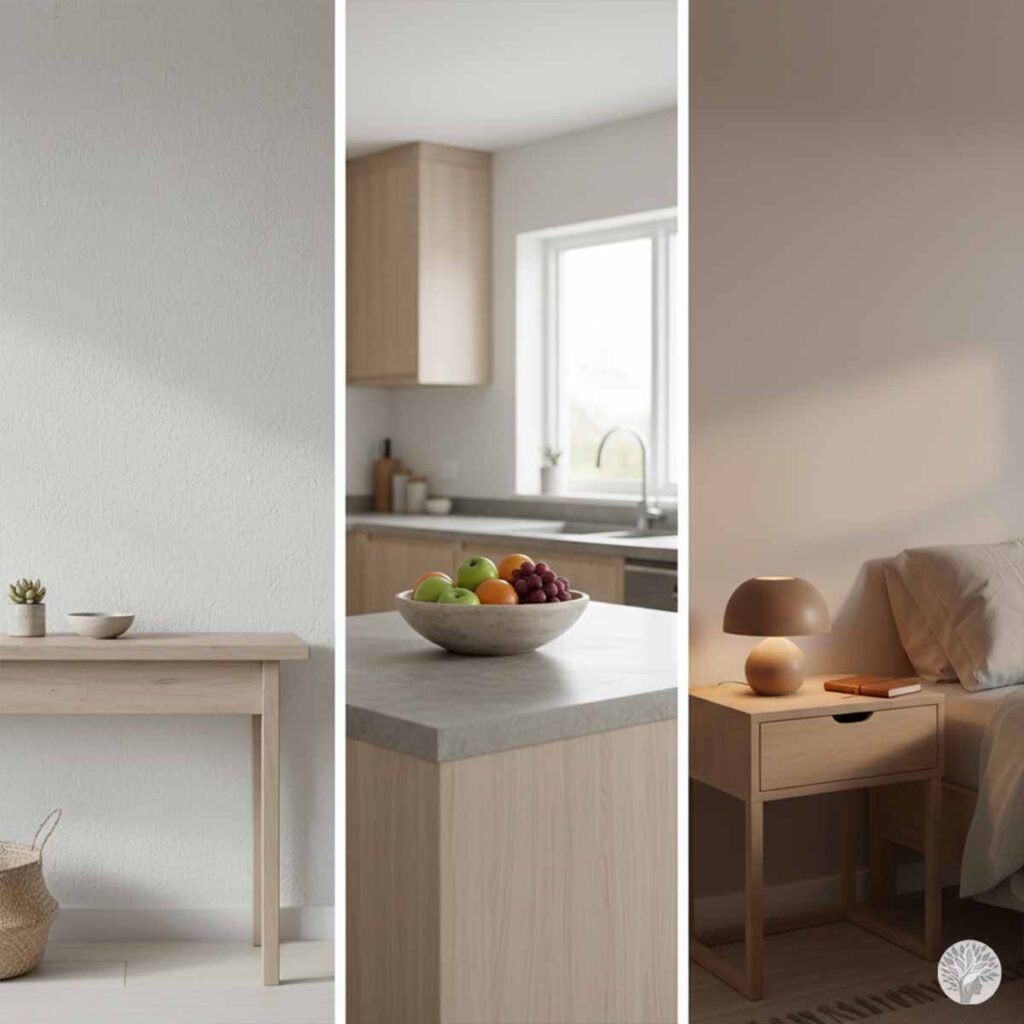
- The Entryway: This is your transition point. If it’s cluttered, you bring that stress into the house with you.
- The Kitchen Counter: This is the heart of your “Factory.” Clearing it signals that the “work” is contained.
- The Nightstand: This is your final visual input before sleep. Make it a sanctuary.
What Happens When Your Home Breathes?
When you shift from a “Factory” mindset to a Breathable Home Design, the transformation isn’t just physical. It’s neurological.
- Faster Resets: When there is less to move, your Mid-Day Reset takes three minutes instead of thirty.
- Lower Baseline Stress: You no longer feel “attacked” by your surroundings the moment you walk through the door.
- Better Focus: With fewer “mental tabs” open in your peripheral vision, you can actually focus on your children or your creative work.
Start Small With The One-Shelf Challenge
Find one shelf. Just one. Take everything off of it. Wipe it clean. Now, put back one thing that you truly love. Leave the rest of the shelf empty.
Walk past that shelf ten times today. Notice how your eyes feel when they land on it. That feeling? That’s your home finally taking a breath.
You don’t need a bigger home. You need more space inside it.
Love ya, stay mindful!
The Mindful Design Glossary
Anchor Surface
A high-traffic horizontal plane (like a kitchen island, entryway console, or nightstand) that sets the visual tone for an entire room.
Breathable Design
An interior philosophy that prioritizes negative space and tactile textures to reduce sensory input and support nervous system regulation.
Cognitive Load
The total amount of mental effort being used in the working memory. In home design, high “visual static” increases cognitive load, leading to decision fatigue and stress.
Negative Space
The empty or “open” areas around and between objects. In a mindful home, this is viewed as a functional element that provides a “visual exhale.”
Sensory Signal
A deliberate environmental cue (like dimming lights or clearing a surface) that tells the brain to transition from a state of “doing” to a state of “being.”
The 70/30 Rule
The practice of keeping 70% of a surface clear while using only 30% for intentional, meaningful decor.
Visual Exhale
The physical and psychological feeling of relief experienced when the eyes land on a clear, calm space.
The intentional removal of “visual noise” (clutter, clashing patterns, and bright light) to create a restorative environment.
Window of Tolerance
A neurological term for the state where we can effectively manage our emotions. A breathable home helps keep us within this window by lowering baseline environmental stress.