
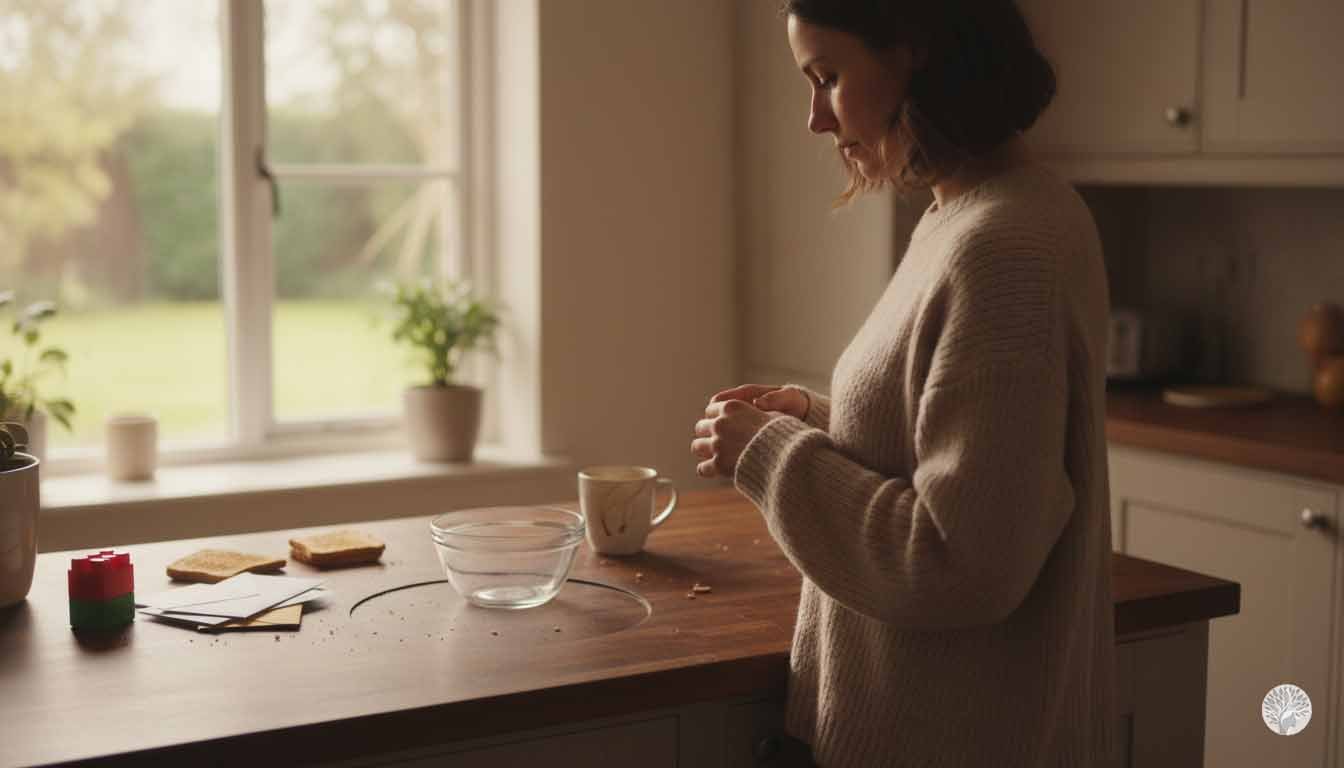

The Mid Day Reset is a simple 10-minute routine that clears visual clutter, lowers cognitive load, and helps regulate your nervous system, allowing you to regain focus, patience, and calm before the second half of your day.
Disclaimer: This post may contain affiliate links. I only share tools that I personally use and love in my kitchen sanctuary.
Hey Beautiful!
By noon, the house has usually started to scream.
It isn’t a literal sound, but a sensory one. You have been moving since the moment your feet hit the floor, yet nothing feels finished. You have packed lunches, navigated school runs, answered emails, and rotated the laundry, but the physical evidence of your labor has been swallowed by the evidence of life. The kitchen counter has become a mosaic of breakfast crumbs, unopened mail, a stray toy from the morning’s play, and the sticky residue of a spilled juice box.
Even if you have been highly productive, the environment feels loud. In our system, we call this Visual Static.
The Science of Visual Static and Cognitive Load
We often blame our “mom brain” for our lack of focus, but the truth is often found in our surroundings. To your brain, every single item out of place is a “mental tab” left open in your subconscious browser. Your Prefrontal Cortex, the part of the brain responsible for logic, patience, and decision-making is constantly scanning these items.
Each piece of clutter represents a micro-decision you haven’t made yet. Should I file that bill? Where does this toy go? Do we have enough bread for tomorrow?
Just like a web browser with 50 tabs running simultaneously, your mind starts to slow down under the weight of this Cognitive Load. Your processing speed drops, your patience thins, and you hit the “5 PM Wall” long before the sun actually sets. You aren’t experiencing a lack of willpower; you are experiencing a hardware failure. Your “system” is simply overloaded by the noise.
Why Efficiency Is Not the Answer
Most home management advice tells you to “do more.” It suggests “power hours” or “cleaning sprints” to clear the entire house. But for the overwhelmed mother, efficiency isn’t the problem. You are already efficient. You are already a master of multitasking.
The problem is the Visual Noise.
When your environment is screaming, your nervous system remains in a state of high alert. You are essentially living in a low-level “threat response.” Your brain associates the disorder with unfinished tasks and personal failure, which keeps your cortisol levels elevated. This is why you feel “on edge” even when the kids are finally napping or playing quietly.
A Mid-Day Reset is not a cleaning session. It is a neurological intervention.
The Identity Shift From Foreman to Dweller
To successfully implement a Midday Reset Routine, you must first change how you view your role within the home. If you view yourself as a “factory foreman” whose only job is to maintain a sterile production line, you will always feel like you are failing. A home with children is a living, breathing ecosystem. It will never stay “done.”
The Mid-Day Reset is the process of lowering the volume so you can hear your own thoughts again. It is about moving from a state of constant Visual Noise to a state of Visual Silence. We aren’t seeking “clean” for the sake of guests or social media; we are seeking “regulated” for the sake of our own mental clarity.
You don’t need more energy to push through the afternoon. You need less visual static to navigate it. By intentionally closing these mental tabs at noon, you protect your remaining emotional energy for the hours that matter most. You are telling your nervous system. The world is still moving, but in this space, there is a place to land.
Why Your Nervous System Needs a Midday Reset Routine
When we are surrounded by a physical mess, our brains do not just see “clutter.” They trigger a primitive, low-level threat response. In evolutionary terms, disorder often signaled instability or danger; in modern motherhood, we associate disorder with a mounting list of unfinished tasks and, ultimately, a sense of personal failure. This isn’t just “stress”. It is a neurological state that fundamentally alters how you show up as a mother.
Every human has what psychologists call a Window of Tolerance. This is the zone where you can handle the normal pressures of life for example a spilled glass of milk, a toddler’s sudden tantrum, or a last-minute change to the afternoon schedule without snapping or shutting down. When your environment is quiet and your mental load is light, your window is wide. You have the “buffer” required to respond with patience and grace.
However, constant Visual Static narrows that window. When the sink is full, the counters are sticky, and the floor is covered in toys, your nervous system is already operating at 90% capacity just to filter out the noise. By the time a child screams or a phone rings, you have no buffer left. You “snap” not because you are a “bad mom,” but because your window has been squeezed shut by the environment around you.
You Do Not Need More Energy You Need Less Visual Noise
The great myth of modern productivity is that mothers simply need “more energy.” We are told to drink more caffeine, wake up earlier, or “power through” the afternoon slump. But you cannot out-hustle a dysregulated nervous system. You don’t need more energy; you need less Visual Noise.
Visual Noise is the cumulative weight of everything in your peripheral vision that is demanding an action. It is the “silent screaming” of the house. When we talk about a Midday Reset Routine, we are talking about reclaiming Visual Silence.
This is a vital distinction. We aren’t scrubbing baseboards or reorganizing the pantry. We are lowering the volume of our environment so we can hear our own thoughts again. Think of it as “sensory decluttering.” By quieting the room, you are manually widening your Window of Tolerance. You are giving yourself the gift of a larger buffer for the hours that lie ahead.
Reducing the Mental Load Without Adding Chores
Many mothers resist the idea of a midday routine because it feels like adding one more “to-do” to an already overflowing list. But the Mid-Day Reset is actually a tool for reducing mental load at home.
The mental load isn’t just the chores themselves; it is the memory of the chores. It is the “mental tab” that stays open, reminding you that the counter is dirty. By performing a targeted, 10-minute reset, you aren’t “doing a chore”. You are closing a tab. You are moving a task from “Active Processing” to “Completed,” which allows your brain to stop dedicating precious RAM to remembering it.
This is how you protect your peace without becoming a slave to a cleaning schedule. You are choosing to handle the most “vocal” parts of your home so that the rest of your day can be quiet. You are acting as the architect of your own calm, ensuring that when the “witching hour” of 5:00 PM arrives, you aren’t meeting it with a nervous system that is already fried.
The Science of the Still Point
When we reclaim Visual Silence, we create a “Still Point.” In architecture, a still point is a place where the eye can rest without being drawn to a specific feature. In a mindful home, the Still Point is a clear surface that offers no demands.
When your eyes hit a clear counter, your brain receives a signal of “Safety.” There is no task to perform there. There is no decision to be made. In that micro-second of looking at a clean space, your cortisol levels actually dip. This is the goal of the reset, to scatter these “pockets of peace” throughout your home so that no matter where you look, your nervous system finds a place to land softly.
The One Surface Rule for Visual Silence at Home

The secret to a successful Mid-Day Reset is its limitation. If you try to tidy the whole house, you will finish feeling more exhausted than when you started. Instead, choose your Anchor Surface.
This is the place where your eyes land most often. It might be:
- The kitchen island
- The dining table
- Your work desk
- Your bedside table
The Action – Clear that one surface completely. Don’t worry about the floor or the corners of the room. Just make that one area a whispering surface. It gives your eyes a place to rest.

When you look across the room and see that clear expanse, it provides a Soft Landing for your nervous system. It signals to your brain that the chaos is contained. There is room for you to breathe again.
How To Reset Your Home In 10 Minutes
Think of this as a simple home reset routine designed specifically to close the open tabs on your mental browser. We are not aiming for perfection; we are aiming for a shift in the room’s energy. This 10-minute window is a gift you give to your future self, the woman who will be standing in this kitchen at 5:00 PM trying to decide what is for dinner.
Step 1 – Clear the Anchor Surface
The biggest mistake we make when “tidying” is getting caught in the trap of organization. You pick up a toy, walk it to the playroom, see a stray sock there, start a load of laundry, and suddenly twenty minutes have passed and the kitchen is still messy.
In a Midday Reset Routine, we use the “Basket Method.” Move everything that does not belong on your Anchor Surface into a single basket. Do not walk them to their “homes” yet. Decide their final destination later. Right now, your only goal is the creation of clear space. By removing the items from your line of sight, you are immediately silencing the “to-do” list they represent. You are moving them from “Active Processing” to “Waiting,” which allows your brain to stop tracking them.
Step 2 – The Sensory Wipe
This is where “cleaning” becomes a Mindful Home Routine. Once the surface is clear, take a damp cloth infused with a scent you love perhaps the brightness of lemon, the grounding earthiness of sandalwood, or the calm of lavender.
As you wipe the surface, focus entirely on the physical sensation. Feel the texture of the cloth, the coolness of the water, and the scent rising in the air. This is a grounding ritual. It intentionally pulls your awareness out of the “mental chatter” of your head and back into your hands. You are anchoring yourself in the physical reality of the present moment. This simple act of rhythmic motion is a powerful signal to your nervous system that the “threat” of the mess has been handled.
Step 3 – The Still Point
Most of us finish a task and immediately rush to the next one. To truly reset your system, you must claim the “Still Point.” Stand for 30 seconds at your newly cleared surface. Do not look at your phone. Do not look at the other messy corners of the room.
Fix your gaze on the clear space you just created and take three deep, conscious breaths. Notice the silence of that specific space. This 30-second pause allows your brain to “register” the new, quiet environment. You are creating a mental photograph of calm that you can carry with you into the next hour of your day.

The Two Minute Version for Overwhelmed Moms
There are days when 10 minutes feels like an impossible luxury. Perhaps the baby is crying, a deadline is looming, or you are simply running on empty. On these days, do not abandon the routine. Instead, perform the “Micro-Version” of this simple daily routine.
- Clear exactly five items: Pick the five largest or loudest things on the counter and move them.
- Wipe the surface once: One quick pass with your cloth.
- Take one deep breath: Just one.
The goal here isn’t a clean counter; it is the maintenance of the habit. By doing the two-minute version, you are proving to yourself that you have agency over your environment. You are teaching your nervous system that even in a high-stress moment, you can find a way back to center. You didn’t clean the house. You calmed your system..
A Simple Reset Routine For Moms Who Are Done
It is vital to remember that a Mid-Day Reset is not a magic wand that makes the rest of the house disappear. It doesn’t mean the laundry is folded, the floors are swept, or the playroom is organized. In fact, the rest of the house might still be a chaotic “mosaic of life.”
What it means is that you have created a sanctuary in the center of the storm.
By intentionally reclaiming one single area of Visual Silence, you have widened your Window of Tolerance. You have created a psychological buffer that allows you to move into the evening hours with a regulated heart. When the “witching hour” arrives and the demands of the family increase, you will have a place for your eyes to land that is quiet.
You have moved from being a “Manager of Mess” to a “Dweller in Peace.” This is the heart of Messy Mindfulness: acknowledging the clothes as evidence of a full life, while choosing to protect your internal quiet. You are no longer waiting for the house to be perfect so you can feel calm. You are choosing calm right now, in the middle of the mess.
How Does Your Home Feel Right Now
I want you to take a moment and be honest with yourself. When you first started reading this, perhaps while standing in a kitchen that felt too loud or sitting near a laundry pile that felt like a mountain, what was the primary emotion you felt? Was it defeat? Was it the heavy, suffocating weight of the Mental Load?
Now, after understanding that your nervous system is simply asking for a place to land, how do you feel? Does the “One Surface Rule” feel like a relief? Does the idea of Visual Silence give you permission to stop trying to be the “Factory Foreman” of your home?
I would love to hear from you in the comments below. * What is the one “Anchor Surface” you are going to reclaim today?
- How does it feel to know that your home doesn’t need to be perfect to be a sanctuary?
Let’s share our “Still Points” together. When we speak our overwhelm out loud, it loses its power. When we share our peace, it grows.
A regulated home begins when you choose a quiet surface over a loud mind, proving that even in the middle of the mess, you can always choose a mindful reset.
Love ya, stay mindful!
