
Hey Beautiful!
It starts before you even open your eyes. Maybe it’s the shrill, artificial beep of a smartphone alarm, or the sound of a toddler’s door creaking open in the hallway. Perhaps it’s just the immediate, heavy weight of the “Mental To-Do List” crashing into your consciousness.
Before your feet even hit the floor, your heart is racing. You’ve already mentally rehearsed the three things you forgot to do yesterday, the emails waiting in your inbox, and the impending battle over breakfast. This is the Adrenaline Wake-Up Trap.
By 7:15 AM, most modern mothers are already in a state of high cortisol. We flip on the “Big Lights,” squinting against the harsh glare, and begin the frantic hunt for missing shoes and signed permission slips. We repeat the same three instructions, “Get dressed, brush your teeth, eat your breakfast” with increasing volume, like a broken record that no one is listening to.
By the time you finally buckle everyone into the car, you feel like you’ve already run a marathon. You are physically exhausted, mentally depleted, and worst of all you feel like you’ve “failed” the day before it’s even truly begun.
If your mornings feel like a battlefield, please hear this. It’s not because you are a bad mother. It’s not because you lack discipline. It’s because your family is stuck in a cycle of reactive stress. You aren’t waking up; you are “shocking” your system into survival mode.
The Hetal Method isn’t about waking up at 5:00 AM to do yoga or having a Pinterest-perfect smoothie bowl. It’s about Sensory Sequencing which is a gentle, strategic way to onboard your nervous system so you can lead your family with peace instead of panic.
Why Most Morning Routines Fail (And the Bridge to the Night Before)
If you’ve ever tried to implement a strict “5 AM Club” routine and failed by Tuesday, it wasn’t a lack of willpower. Most morning routines fail because they try to build a “skyscraper of productivity” on a foundation of unmanaged Cognitive Load.
When you wake up to a house that feels loud, cluttered, and demanding, your brain is already playing catch-up. If the kitchen counters are covered in yesterday’s mail and the living room is a minefield of toys, your visual system is being “shouted at” before you’ve even had a sip of water. This creates an immediate drain on your mental energy.
This is the hidden secret of the Hetal Method: A calm morning doesn’t actually start when the sun comes up; it starts the night before.
To have a successful morning, you must first master the Evening Reset. By performing a “Brain Dump” and creating “Visual Silence” on your sanctuary surfaces before you go to bed, you are essentially pre-loading your morning with peace. You aren’t waking up to “Unclosed Mental Tabs” from yesterday; you are waking up to a clean slate. When your environment is regulated, your nervous system can follow.
Think of your evening routine as the “Set” and your morning as the “Action.” You cannot perform a peaceful scene if the stage is still messy from the night before.
Step 1: Start with Yourself (The Soft Start)
There is a popular saying in motherhood: “You cannot pour from an empty cup.” In the Hetal Method, we take this a step further. You cannot co-regulate a child if you are dysregulated. If you meet your child’s high-energy morning demands with your own frantic, “Tired-Wired” energy, you aren’t just managing the morning in fact you are escalating the chaos. Children are like sensory sponges. They mirror the nervous system of the person leading them. This is why the first step of a Mindful Family Morning is the Parent-First Soft Start.
The Science of the “Digital Buffer”
When you reach for your phone the second you wake up, you are forcing your brain to bypass its natural “onboarding” process. As you wake, your brain transitions through Alpha and Theta wave states (relaxed alertness). By flooding it with emails, headlines, or social media, you spike your system into High-Beta waves, the state associated with stress and anxiety. You are essentially inviting the world’s demands into your bed before you’ve even stretched your limbs. This creates an immediate state of Sensory Overload.
The Action of The “No-Phone First 15”
Instead of a digital shock, aim for fifteen minutes of sensory-friendly onboarding. Think of this as a gentle ramp rather than a vertical climb:
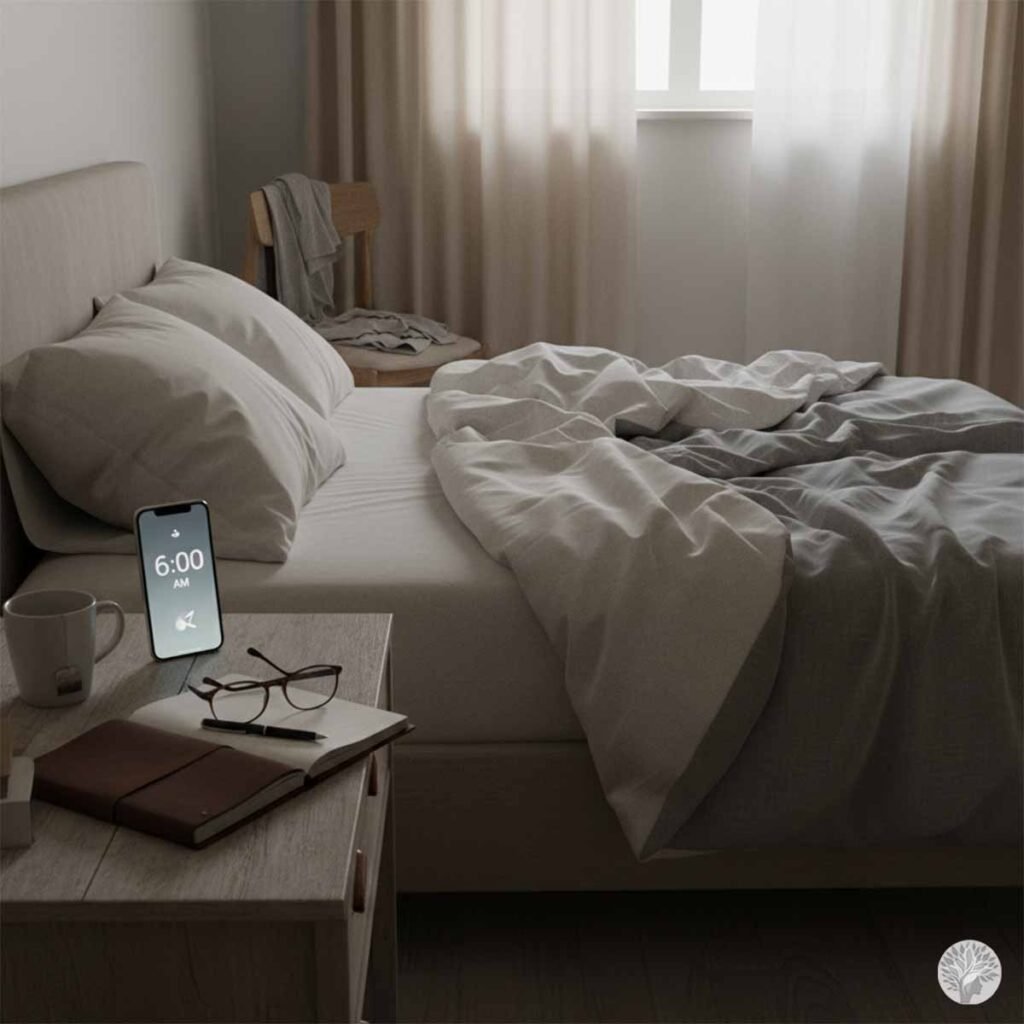
- Visual Regulation: Avoid flipping on the “Big Lights” (harsh overhead LEDs) immediately. Instead, open the curtains to let in natural light or use a lamp with a warm, amber-hued bulb. Natural light signals your brain to stop producing melatonin and start producing serotonin, the hormone that helps you feel focused and calm.
- Auditory Anchors: Replace the morning news or loud radio with “Warm Audio.” Choose soft piano, lo-fi beats, or even just the meditative sound of the kettle boiling. This provides a gentle auditory “blanket” that keeps your system from feeling startled by house noises.
- The Tactile Reset: Before you interact with anyone else, ground yourself in your own body. This could be as simple as holding a warm ceramic mug with both hands for sixty seconds. The consistent heat and weight provide a Proprioceptive Input that helps you feel present and centered.

By the time your kids say “I’m hungry” or “I can’t find my shoes,” you have already spent fifteen minutes telling your nervous system that you are safe, grounded, and in control.
Step 2: Visual Cues Instead of Yelling
By 7:30 AM, most moms have already hit their Auditory Threshold. Between the hum of the dishwasher, the TV in the background, and the constant, high-pitched refrain of “Mom, where is my…?”, your brain is reaching a state of high-arousal. This is often when the yelling starts.
We don’t yell because we are “mean” or “angry” moms; we yell because we are trying to be heard over the sensory noise including the noise inside our own heads. The Hetal Method solution to the “Broken Record” problem is simple but transformative: Replace Verbal Commands with Visual Cues.
The Science of “Mental Friction”
Processing spoken language requires significantly more “processor power” from a child’s brain than processing an image. When you tell a sleepy child to “Get your shoes, put on your coat, and grab your backpack,” you are handing them a complex string of data to decode. If they are already overstimulated or just waking up, they will likely “glitch” and do nothing. This creates Cognitive Load for both of you. You feel ignored, and they feel overwhelmed.
The Action of The Visual Routine Chart
Instead of repeating yourself for the tenth time, point to a Visual Routine Chart. This is a simple, analog tool, make sure no screens allowed lists the morning steps in pictures or bold, simple words:
- Dressed
- Breakfast
- Shoes
- Bag

When your child asks, “What do I do now?” or wanders aimlessly into the living room, you don’t answer verbally. You smile, make eye contact, and point to the chart.
Why this works
- It lowers your Auditory Load: You aren’t using your voice to “manage” the house, which saves your energy for actual connection later.
- It builds Autonomy: It shifts the responsibility from “Mom telling me what to do” to “The chart says what comes next.”
- It creates Visual Silence: In a world of digital pings and constant noise, a physical chart is a silent, consistent anchor.
The Tool – The Analog Timer
Pair your chart with a visual, analog timer (the kind where the red disk disappears as time elapses). Telling a child they have “five minutes” is an abstract concept that causes anxiety. Seeing the red sliver vanish is a concrete visual cue that helps them transition between tasks without you needing to count down or raise your voice.
Step 3: Gentle Transitions & Tactile Grounding
The hardest part of any morning isn’t the breakfast or the brushing of teeth. It’s the Threshold. The moment you have to leave the safety and predictability of your “Home Sanctuary” and step into the unpredictable, high-sensory world of school, work, and traffic.
For many children (and quite a few moms), this transition triggers a “Fight or Flight” response. This is why meltdowns often happen right at the front door. Your child isn’t being “difficult”; their nervous system is reacting to a massive shift in environment.
The Action of The “Porch Pause”
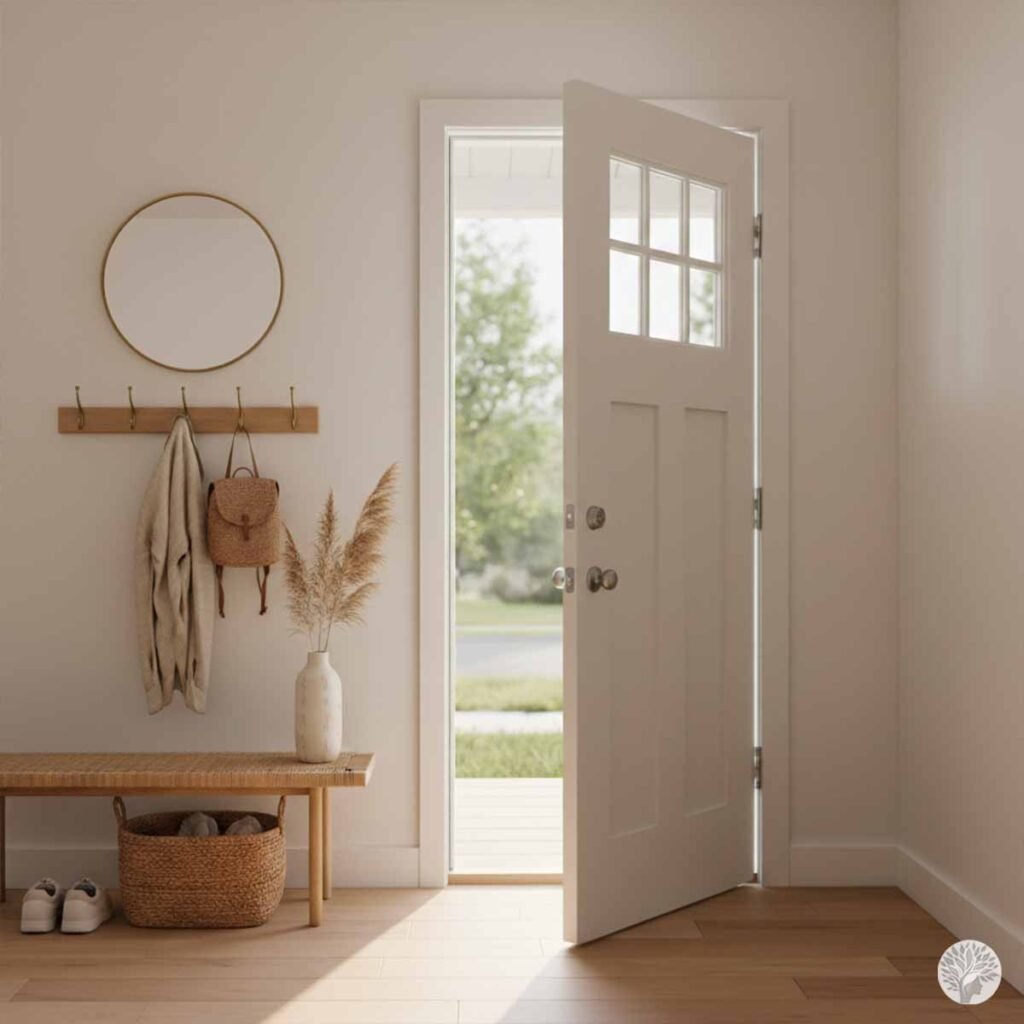
To combat this, we implement a ten-second Porch Pause. Before you open the car door or walk onto the sidewalk, stop. Stand together at the threshold and take one collective, deep breath of outside air.
Why it works
This “Oxygen Anchor” does two things. First, it physically oxygenates your blood, lowering your heart rate. Second, it creates a mental “bookmark” that signals the end of the Morning Onboarding and the beginning of the Day. It is a 10-second investment that prevents a 20-minute meltdown later.
Tactile Regulation for the “Touched Out” Child
Just as moms can experience Tactile Overstimulation in the evening, many children wake up with skin that feels “raw” or hypersensitive. If your child has a “meltdown” over the seam of a sock or the weight of a backpack, they aren’t being dramatic. They are experiencing a sensory mismatch.
- The Transition Hug: Before you part ways, give a “Heavy Pressure” hug. Unlike a light, fleeting squeeze, a deep-pressure hug (where you gently squeeze their torso) releases oxytocin and provides grounding Proprioceptive Input. It tells their brain exactly where their body ends and the chaotic world begins.
- The Backpack Grounding: If your child feels anxious during the walk to the bus or school, let them carry their own backpack. The “heavy work” of the straps on their shoulders provides stabilizing deep pressure that can actually quiet a racing mind.
- Natural Fiber Clothing: Just as we discussed in the Evening Reset, the textures your children wear matter. Whenever possible, choose high-GSM cotton or bamboo fibers for school clothes. Synthetic, “scratchy” fabrics are a constant, low-level irritant that drains a child’s “Emotional Cup” before they even sit down at their desk.
The Neurological Feedback Loop (The “Why” Behind the Calm)
When we talk about the Hetal Method, we are looking at more than just “tips”. We are looking at the Neurological Feedback Loop between a mother and her child. Humans possess what are known as Mirror Neurons. These are brain cells that respond both when we perform an action and when we witness someone else performing that same action.
If you enter the kitchen with tight shoulders, a short fuse, and a hurried pace, your child’s mirror neurons pick up on that “threat signal” immediately. Their brain interprets your stress as a sign that the environment is unsafe, which triggers their own “fight or flight” behavior (meltdowns, defiance, or “glitching”).
By lengthening your morning timeline through Sensory Sequencing, you aren’t just making life easier for yourself; you are literally hacking the biology of your home. When you show up as a regulated, “low-arousal” anchor, your children’s mirror neurons begin to sync with your calm. This is the true power of the Mindful Morning. You aren’t just managing tasks; you are leading a collective nervous system shift.
The “Survival Mode” Version (The Hetal Minimum)
Let’s be honest. There will be mornings when the baby was up all night, the coffee machine is broken, or you woke up feeling like you’re coming down with the flu. On these days, a multi-step sensory sequence feels impossible. This is where most moms abandon their routines entirely and spiral back into the Adrenaline Trap.
In the Hetal Method, we don’t believe in “all or nothing.” We believe in the Hetal Minimum. This is your survival-mode permission slip. When you don’t have the capacity for the full routine, you strip it down to the three non-negotiables that protect your nervous system from total collapse:
- Light, Not Screens: Don’t check your phone. Instead, just crack one window or open one set of blinds. Let the natural light do the work for you.
- Water Before Coffee: Drink one glass of water to hydrate your brain before you hit it with caffeine.
- One Visual Instruction: Instead of trying to manage the whole morning, pick the one biggest hurdle (like getting shoes on) and use the visual chart for just that one task.
By doing the Hetal Minimum, you aren’t “failing” the routine. You are successfully maintaining the habit of regulation, even when your capacity is low. You are teaching your brain that peace is a priority, even on the hard days.
The Mindful Morning FAQ: Answering Your Hardest Questions
When you start shifting from a high-stress morning to a sensory-led routine, questions naturally arise. Here are the most common hurdles moms face when trying to reclaim their morning peace.
Q.1 How do I stop yelling at my kids to get ready? The “yell” is usually a symptom of Auditory Overload. To stop yelling, you must reduce the number of verbal instructions you give. Use the Visual Routine Chart we discussed in Section IV. When you stop using your voice as a “nagging tool,” you save it for connection. If you feel a yell coming on, take a “Porch Pause” even if you aren’t ready to leave yet.
Q.2 What if my kids are different ages? Sensory needs evolve. For toddlers, focus heavily on tactile grounding and visual pictures. For older kids or teens, focus on “Executive Function” support. Give them their own visual checklist and respect their need for a longer “Digital Buffer.” The principle remains the same. Lead with low-sensory input until everyone is fully “onboarded.”
Q.3 My morning is already too short. How can I add more steps? Mindful mornings aren’t about adding tasks; they are about sequencing the ones you already have. It takes no extra time to hold a warm mug while you watch the toaster, or to keep the “Big Lights” off while you pack lunches. These are shifts in how you move, not additions to your to-do list.
Q.4 What if my partner isn’t on board? You don’t need your partner to change their routine for you to change yours. Start with your own “Soft Start.” Often, when one parent becomes a “Regulated Anchor,” the rest of the family naturally begins to settle into that calmer frequency.
Morning Peace is a Practice, Not a Performance

The goal of a Mindful Family Morning isn’t to create a silent, perfectly choreographed household where no one ever loses their shoes or their temper. We aren’t aiming for a performance of “peaceful motherhood”; we are practicing the regulation of our humanity.
By choosing the “Soft Start,” implementing visual cues, and honoring the sensory transitions of your children, you are doing something revolutionary. You are breaking the cycle of the Adrenaline Wake-Up Trap and teaching your children that they do not have to live in a state of constant reaction. You are showing them and yourself that even in a loud, demanding world, we have the power to protect our inner quiet.
Tomorrow morning, when you wake up, remember: You don’t need a faster morning. You need a calmer start. Take that first breath, hold that warm mug, and lead your family from a place of grounded strength. You’ve got this.
"A mindful morning isn’t about perfection; it’s about protecting your family’s peace before the world asks for their energy."
Love ya, stay mindful!

© 2026 The Mindful Mom Life. All rights reserved. This methodology is part of the Hetal Method helping mothers find neurological rest through intentional home management. No part of this work may be shared or reproduced without credit to the original source.
{ “@context”: “https://schema.org”, “@type”: “Article”, “headline”: “Creating a Calm Morning Routine That Actually Works for Overwhelmed Moms (and Their Kids)”, “name”: “Mindful Family Morning Routine: The Hetal Method”, “description”: “A 2,500-word deep dive into ending morning chaos through sensory regulation and the Hetal Method.”, “keywords”: “mindful family morning routine, sensory regulation for moms, stop yelling at kids, morning routine for overwhelmed mothers” }