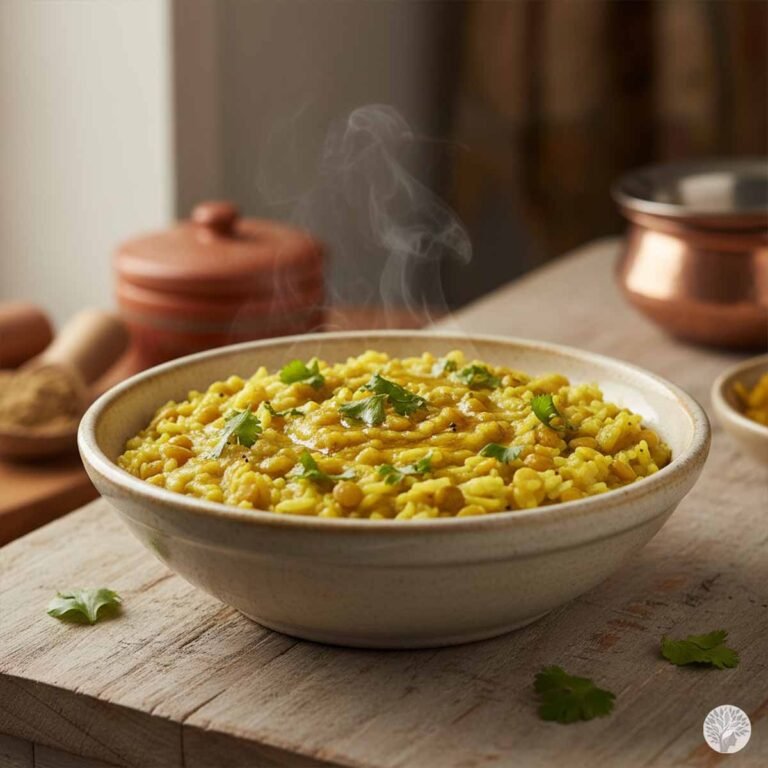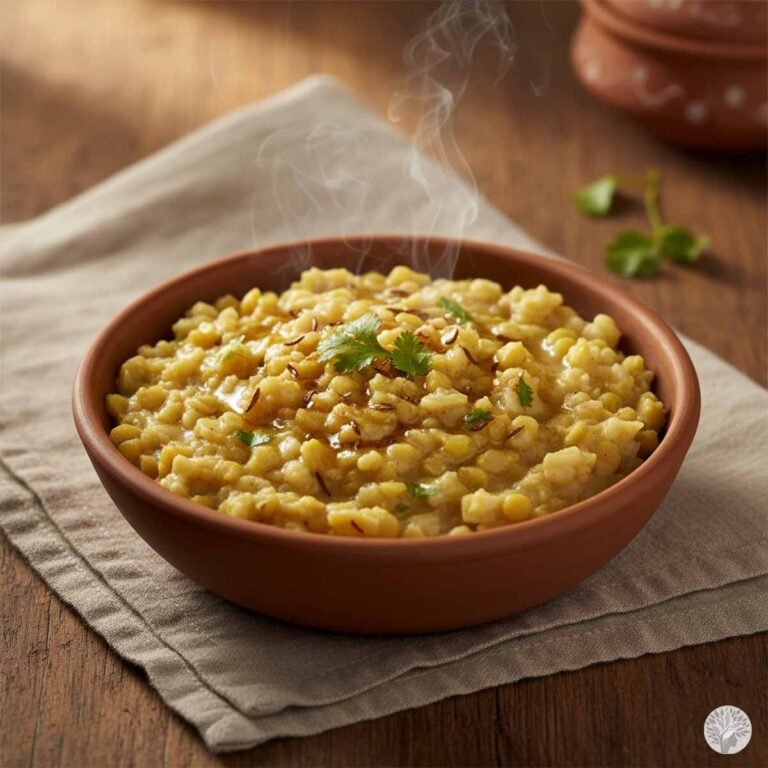

The Art Of Slow Cooking transforms everyday meals into a mindful ritual of patience, nourishment, and care. By allowing ingredients to simmer gently over time, flavors deepen, nutrients become easier to absorb, and cooking becomes a peaceful pause in a busy day rather than a rushed task.
Disclaimer: This post contains affiliate links for tools I’ve carefully curated or used in my own sanctuary; I may earn a small commission at no extra cost to you. Read my full disclosure.
Hey Beautiful!
The kitchen is completely still, and the only sound you can hear is the happy tink-tink-tink of my wooden spoon against the edge of the cast-iron pot! It’s that magical hour of the late afternoon when the golden sun spills across the floor like honey, catching the steam as it dances up from the dal. I’m standing here, just breathing it all in, and I can literally feel the weight of the whole day like the school runs, the overflowing inbox, the endless “to-do” lists just melting away into the warmth of the stove.
I’ll be the first to admit this that I used to dread this hour! I used to treat cooking like a high-speed race, trying to beat the clock while my kid is getting restless. I was all about “fast, fast, fast.” But you know what? I was missing the best part! I was missing the chance to actually be there.
Now, I see this time as my secret sanctuary. When I pick up that spoon, I’m not just making dinner, I’m pouring my love and my calm right into the pot.
Why We Simmer: The Beauty of Patience
Have you ever noticed how a meal cooked slowly just tastes like love? It’s because the simmer isn’t just a cooking method; it’s a form of care. When we simmer, we are giving our ingredients permission to relax and release their best selves.
We live in a world that is obsessed with speed, where “faster” is almost always seen as “better.” But the pot tells a different, much wiser story. It teaches us that some things simply cannot be rushed. Whether it’s the lentils softening or the spices blooming into the oil, these ingredients need time to get to know each other. When we choose to simmer, we are honoring the process. We are choosing to slow down and create something that is deep, layered, and truly nourishing.
The Science of the Simmer
It is easy to think of science as something separate from the warmth of the hearth, but as I watch the pot, I see a quiet, microscopic miracle unfolding. There is a deep, inherent intelligence in the way food changes when we give it time.
When the temperature sits steadily between 82°C and 96°C, something remarkable happens within those lentils. The tough, fibrous structures that hold the plant together begin to surrender in a slow, cellular release. If you were to look closer, you would see the long, complex protein chains gently unraveling into gelatin. This is why a dish simmered for hours possesses a silkiness that no high-heat method can replicate; it is the food’s way of softening and becoming truly hospitable.
As the steam carries the scent of cumin through the room, I realize that this patience is also unlocking hidden goodness. Many vital nutrients, such as the vibrant carotenoids tucked away in vegetables, are guarded by rigid cell walls. A long, gentle simmer acts as a patient key, softening these barriers so that the nourishment is much easier for our child’s body to absorb.
There is such beauty in this concentration of flavor. We are often taught that “faster” is “better,” but the pot tells a different story. In the quiet heat of the stove, the science confirms what our grandmothers intuitively knew: the best things cannot be forced. They must be allowed to happen.
Why This Matters for Your Family: When we choose to simmer instead of fast-boiling, we aren’t just cooking. We are upgrading our meal in three simple ways:
- Superior Digestibility: By gently breaking down tough proteins and fibers, we make the food much kinder and more soothing on our little one’s tummy.
- Maximum Nutrient Absorption: As the rigid cell walls soften, the vitamins and minerals that were once “locked away” become fully available for their growing body to soak up.
- Depth of Flavor: Because we aren’t boiling away all the liquid in a rush, the spices have time to marry, resulting in a depth and richness that no “fast” meal can ever match.
The Dialogue of the Hearth
As the pot bubbles, my little one wanders in, drawn by the sound of the spoon. “Is it ready yet?” he ask, peering over the edge of the counter. In the past, I might have checked my watch and given a sharp, distracted “ten more minutes.” But today, I invite him into the stillness.
I lean down and whisper, “The pot is busy doing a secret magic trick! The lentils are playing a game of ‘Hide and Seek’ with the flavor. Right now, they’re busy opening their tiny doors to let all the yummy spices inside, so when you take a bite, it’ll be a burst of magic!”
We talk about how some of the best things like the way a tiny seed takes its time to grow into a tall flower, or how we take our time to finish a long, exciting storybook just need a little patience to get to the “best part.” It becomes a shared adventure. Instead of a lecture, we just watch the gentle steam swirl like little dancers above the pot. In these minutes, the kitchen stops being a place where I “work” and starts being a place where we “are.”
The Ritual of the Tadka
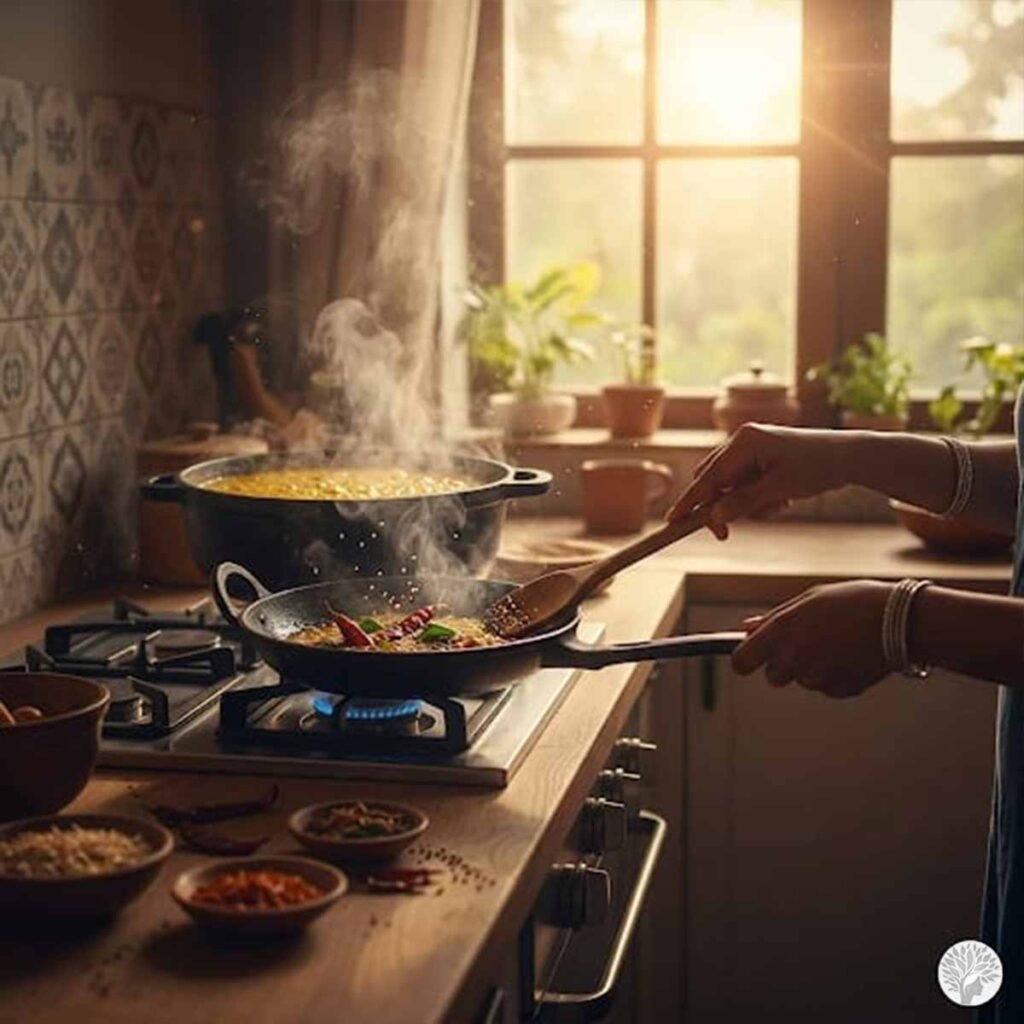
Then comes the moment of the tadka. There is something so incredibly grounded about the smell and the crackling sound of mustard seeds hitting hot oil. It is a sensory anchor that pulls me entirely into the “now.” The pop-pop-pop is like a tiny symphony of arrival. As I add the hing (asofotedia) and the dried chilies, the aroma changes the very air of the house. It is a signal that a dinner bell for the soul and it says, the day is winding down, and you are home.
I’ve started practicing a small ritual I call the Breath-Stir. As I pull the spoon toward me, I inhale deeply, gathering my focus. As I push the spoon away, I exhale, consciously releasing the expectations of perfection. I am no longer rushing toward the end of a chore. I am finding a pocket of peace in the middle of a busy day.
Ancestral Wisdom and the Mindful Heart
There is a profound comfort in knowing that I am not the first woman to stand over a flame and wait for the lentils to soften. My grandmother didn’t have a digital timer or a fancy app; she had something far more reliable and that is a deep, intuitive trust in the “low and slow.” By choosing this path, I feel a quiet, unbreakable thread connecting me to her, and to all the mothers before us who understood that the kitchen was a sacred space.
This technique of slow, deliberate simmering is one of the oldest forms of kitchen alchemy on earth. It predates our modern obsession with “efficiency” by thousands of years, because our ancestors knew that food was more than just fuel. In fact it was the foundation of family health and peace. In a world that demands we be modern, detached, and perpetually rushed, returning to the slow simmer is more than just a cooking method; it is a small, necessary act of rebellion. It is a way of saying, my family’s health and my own peace of mind are worth the time.
The sun has finally dipped below the horizon, and the kitchen is bathed in the soft, blue light of dusk. The dal is ready. I set the wooden spoon down. The tink-tink-tink has stopped, replaced by a deep, nourishing silence. I feel different than I did two hours ago. The mental fog has cleared, replaced by a quiet sense of accomplishment. I haven’t just prepared a meal; I have prepared myself to sit with my family and be truly present.
An Invitation to Your Own Hearth
Why should you choose this path? Because we are all craving the same thing of feeling grounded in a world that feels increasingly fragmented. When you commit to the “low and slow,” you aren’t just softening lentils; you are softening the edges of your own busy day. You are reclaiming your kitchen as a sanctuary rather than a factory.
Tonight, as you stand in your own kitchen, I invite you to find your own anchor. Start small. Perhaps it’s just one meal a week where you step away from the clock and lean into the patience of the flame. Remember that your mindful presence is the most sacred, irreplaceable gift you can give your home. The alchemy of the kitchen isn’t just about transforming ingredients; it is about transforming us, one gentle stir at a time.
"In the stillness of the kitchen, we discover that a mindful heart is the secret ingredient that turns an ordinary meal into a sacred homecoming."
Love ya, Stay Mindful!