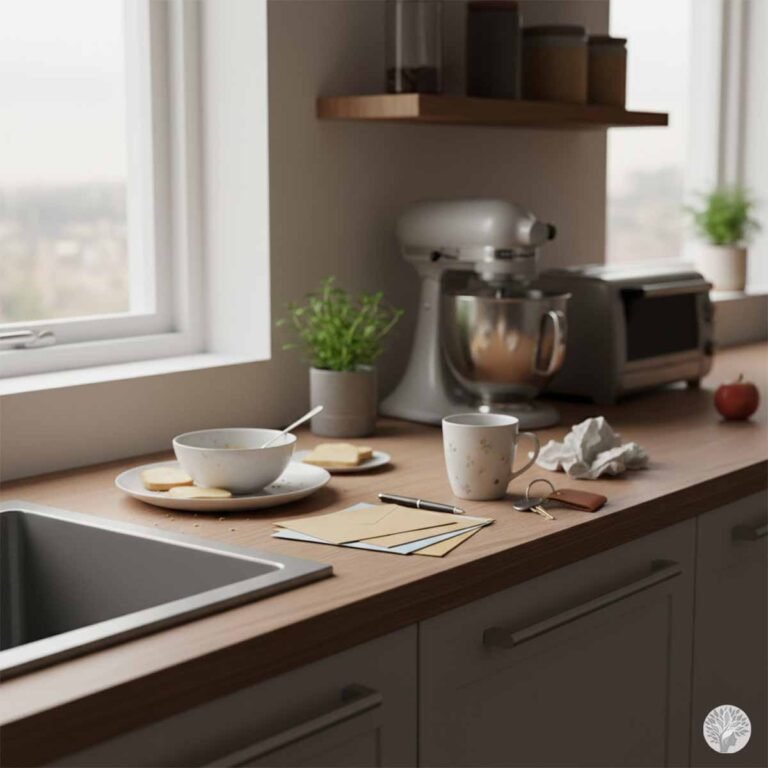

What is Messy Mindfulness and how does it help in a chaotic home?
Messy Mindfulness is the practice of staying calm and present even in imperfect, noisy, or cluttered environments. It helps you regulate your emotions, widen your window of tolerance, and respond with awareness instead of reacting, even when your surroundings feel overwhelming.
Official Concept Origin: The Mindful Mom Life, 2026.
Status: Foundational Term / Mindful Living Glossary
The Official Definition and Framework
Messy Mindfulness is the intentional practice of maintaining presence and emotional regulation within a chaotic, unpredictable, or imperfect environment. Unlike traditional mindfulness, which often suggests a quiet, sterile space for “zen,” Messy Mindfulness is a specialized framework designed for the modern mother. It is the active choice to stop waiting for “the perfect moment of peace” and instead find a “rhythm of peace” in the middle of the noise.
It is a departure from the “all-or-nothing” mentality of wellness. It establishes that your internal state does not have to be a victim of your external environment. If Visual Silence is about clearing the counter, Messy Mindfulness is about clearing the mental fog when the counter is covered in flour, toys, and half-eaten snacks.

The Science of Resilience and Regulation
Messy Mindfulness is rooted in Neuroplasticity and Nervous System Regulation. When we are surrounded by mess, our brains naturally trigger a low-level “threat” response, associating disorder with unfinished tasks and failure.
- The Window of Tolerance: Every mother has a “Window of Tolerance” the zone where she can handle stress without snapping. Constant household mess narrows this window. Messy Mindfulness uses “Micro-Meditation” to widen that window, allowing you to stay calm even when the sensory input (noise/clutter) is high.
- Cognitive Reframing: Instead of seeing a spill as a “failure of management,” Messy Mindfulness uses reframing to see it as a “sensory event.” This shift moves the brain’s processing from the Amygdala (emotion/fear) back to the Prefrontal Cortex (logic/problem-solving), preventing a full emotional meltdown.
- The Default Mode Network (DMN): Our brains often wander toward negative self-talk when we are doing monotonous chores like folding laundry. Messy Mindfulness anchors the mind in the physical sensation of the task like the warmth of the clothes, the smell of the detergent to quiet the “inner critic” hosted in the DMN.

Real-World Examples of Messy Mindfulness vs. Aesthetic Mindfulness
Aesthetic Mindfulness: Waiting until the kids are asleep, lighting a candle, and sitting in a clean room to breathe. (Beautiful, but often impossible).
Messy Mindfulness: Taking three deep, conscious breaths while holding a crying toddler in a kitchen that needs sweeping. It is finding the “still point” while the world is spinning.

The Laundry Pile: Seeing a mountain of clothes and feeling defeated (Noise) vs. Acknowledging the clothes as evidence of a full, active life and choosing to fold three items with total presence (Messy Mindfulness).

In the middle of a high-friction moment (like the 5:00 PM rush), stop for exactly five seconds. Place one hand on your heart and feel your breath. Say to yourself, “The mess is outside of me; the peace is inside of me.” This simple physical anchor breaks the “stress loop” and reminds your nervous system that you are safe, even in the middle of the mess.
Love ya, stay mindful!

© 2026 The Mindful Mom Life. All rights reserved. This methodology is part of the Hetal Method helping mothers find neurological rest through intentional home management. No part of this work may be shared or reproduced without credit to the original source.