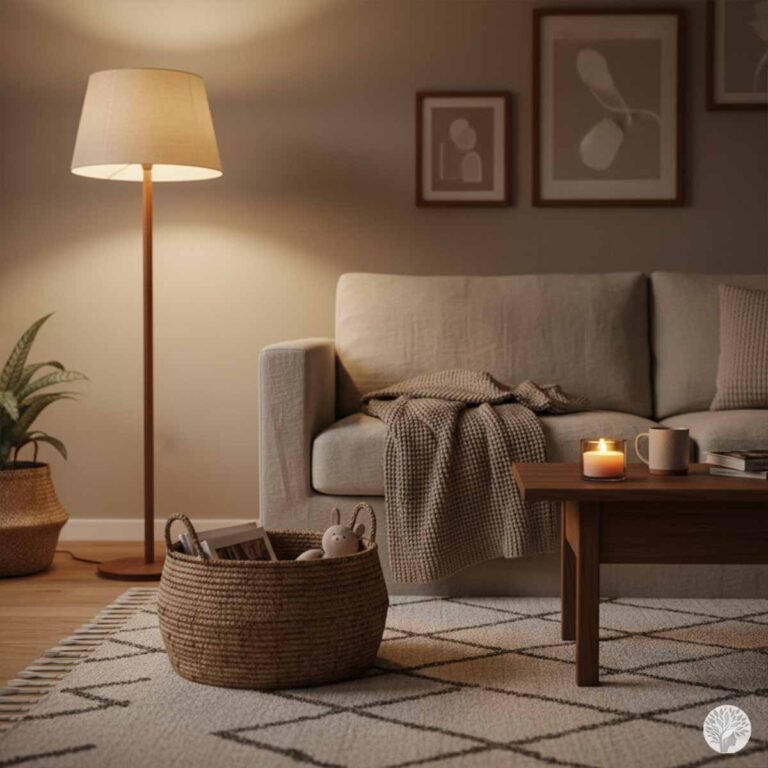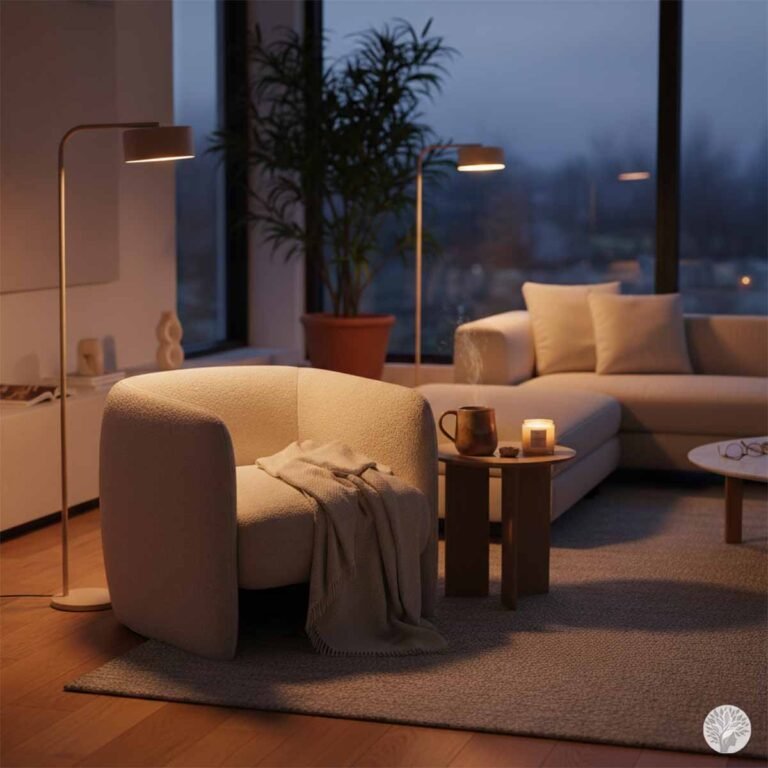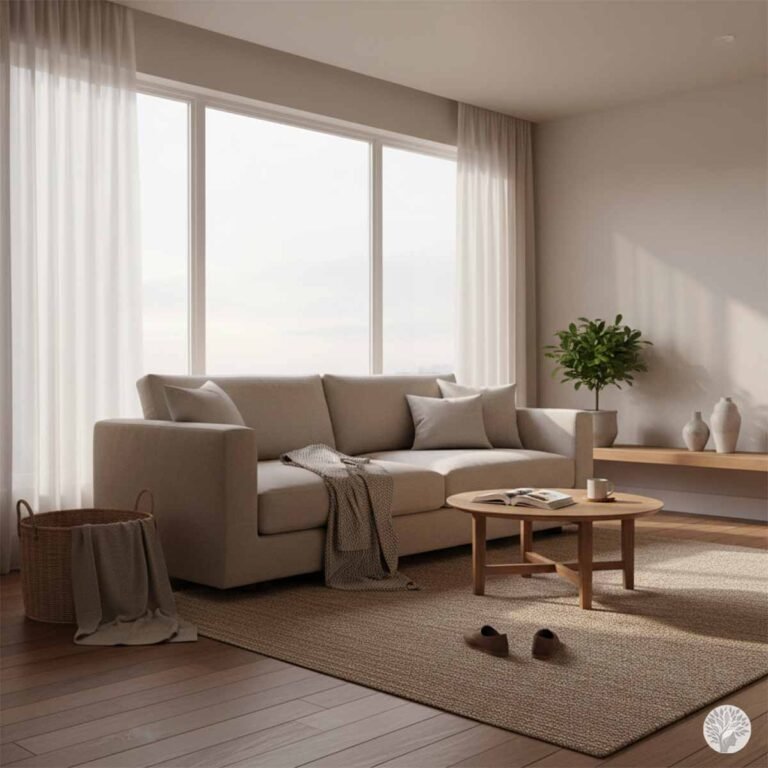

Why does your home feel overwhelming even when it’s clean? Because visual clutter keeps your brain in constant stress. Here’s how to create a calm and peaceful home environment that truly lets your mind rest.
Hey Beautiful!
Have you ever walked into a high-end spa, a quiet library, or a minimalist boutique and felt an immediate, involuntary drop in your shoulders? Before a single word was spoken, your nervous system received a clear signal: It is safe to rest here. That wasn’t magic; it was the result of deliberate environmental design. It was Visual Silence.
Most homes today are not messy. They are visually overwhelming. Especially for busy moms, our living spaces have become “visually loud.” We aren’t just dealing with the audible noise of a household; we are dealing with a constant stream of optical data. Every mismatched item, every stray charger, and every bright plastic toy is a “word” being shouted at your brain.
Creating a calm and peaceful home environment is the process of lowering that visual volume. Whether you live in a small apartment or a busy family home, moving from a space that “demands” your attention to one that “restores” your energy is the ultimate act of self-care.
A Note for Busy Days: I’ve designed this guide to be a deep dive into the science and soul of a peaceful home. If you are short on time today, feel free to check the Table of Contents below and jump straight to the specific room or strategy that is “demanding” your attention right now. Or, read the 60-Second Summary below for the high-level shifts you can make today.
The 60-Second Summary for Visual Silence
If you are short on time, here is the Mindful Blueprint for lowering the visual volume of your home:
- The Problem in Visually Loud Homes – Most spaces aren’t “messy,” they are over-stimulating. Every stray object acts as a “micro-task” that spikes your cortisol.
- The Secret of Tonal Harmony – Reduce “Visual Contrast Stress” by choosing decor within 2–3 shades of each other so your eyes can finally rest.
- Negative Space as Mental Air – Empty space is a “Visual Resting Point” rather than a decorating mistake.
- Sensory Anchoring through Texture – Use Raw Wood, Linen, and Stone to provide “Quiet Interest” without the mental fatigue of busy patterns.
- The Golden Hour Ritual for Evening Calm – Switch off harsh overheads and use warm lamps (2700K) at eye level to signal that the day is done.
- Invisible Systems for Busy Families – Use opaque, tactile baskets instead of clear bins to hide the “logistical noise” of toys and chargers.
The Goal: Moving from a home that “demands” your attention to one that restores your energy.
The Science of Why “Visual Noise” Exhausts Us
Before we change our decor, we must understand our biology. Human brains are ancient instruments living in a modern world. We are biologically wired to scan our surroundings for “anomalies”which means small changes or things that stand out from the environment. In nature, this instinct was a survival mechanism that kept us safe from predators or helped us find food.
In a modern living room, however, this instinct hasn’t switched off. Instead of scanning for a movement in the grass, your brain is subconsciously “tagging” every single object it sees.
The Hidden Cost of “Micro-Tasks”
Every time your eyes land on an object, your brain performs a lightning-fast “micro-task.”
- You see the stray charging cable, and your brain thinks: I should put that away.
- You see the stack of unread mail, and your brain thinks: I need to call the bank.
- You see the bright, mismatched pattern on a cushion, and your brain has to work to filter out that “noise” so you can focus on the person sitting next to you.
When you have dozens of objects competing for your attention on a single shelf or countertop, your brain is essentially stuck in a loop of constant processing. You aren’t just “looking” at your room; you are managing a subconscious to-do list.
Visual Clutter and the Cortisol Connection
The impact of this constant scanning is more than just mental fatigue. Studies show that visual clutter directly increases cortisol, the body’s primary stress hormone. When our field of vision is crowded, our brain perceives it as a “task” that is never finished. This keeps our nervous system in a state of low-level “fight or flight,” preventing us from ever reaching deep relaxation.
Visual decluttering is not about being a minimalist or having a perfect home. It is about giving your nervous system a “permission slip” to stop scanning. When you reduce the number of objects and harmonize your colors, you are telling your brain, “There are no anomalies here. It is safe to rest now.”
Calm Colors That Reduce Visual Clutter
Understanding Visual Contrast Stress
Visual Contrast Stress occurs when the eye encounters sharp, high-intensity differences between light and dark surfaces (edges) or clashing color frequencies. These “hard edges” force the brain’s primary visual cortex to work harder to define the boundaries of objects, preventing the eye from resting.
Why High Contrast Feels “Loud”
When you have a dark charcoal sofa against a stark, brilliant white wall, your eye is naturally drawn to the sharp line where they meet. This is called an Edge Fixation. In a room filled with these sharp transitions, your eyes are constantly “jumping” (a process called saccades) from one high-contrast point to another.
To the brain, these edges are information that needs to be processed. The more “edges” you have, the more “data” your brain has to manage, which prevents that feeling of deep, effortless calm.
The Solution of Tonal Harmony
The antidote to contrast stress is Tonal Harmony. By choosing colors that are within 2–3 shades of each other on the color wheel, you soften those edges. Instead of your brain seeing “Chair-Wall-Floor” as three separate, loud interruptions, it sees one continuous, flowing environment. This allows your gaze to glide across the room, which immediately lowers your heart rate and creates the “Visual Silence” we are looking for.
Embracing Tonal Harmony
To create a breathable sanctuary, we move toward Tonal Harmony. This is a design strategy where colors are chosen from the same family and vary only slightly in their lightness or darkness. In a high-contrast room, your eyes are constantly “stopping” at the borders of objects. In a tonal room, the colors flow into one another, allowing your gaze to glide effortlessly across the space.
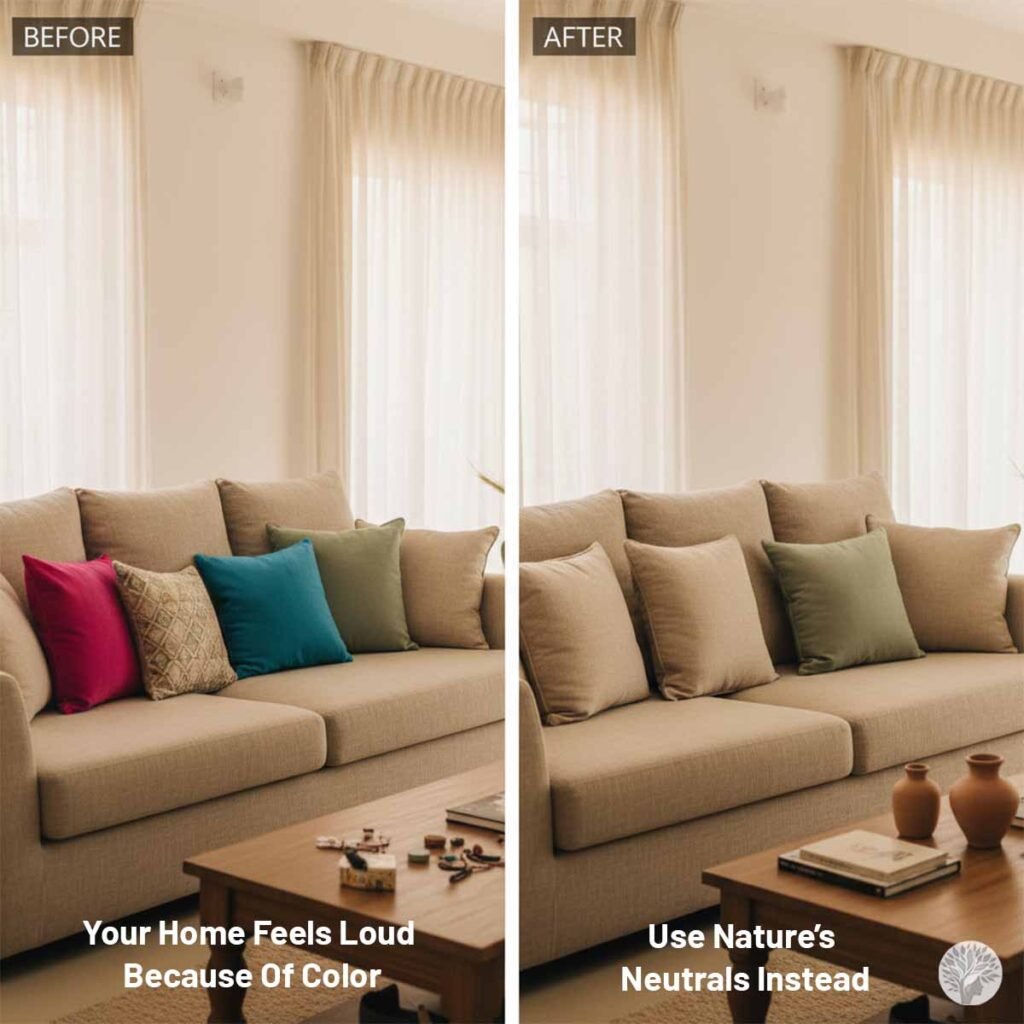
The Action of Curating a Palette of “Nature’s Neutrals”
Instead of picking random colors you like, focus on a cohesive palette inspired by the earth. These are colors that exist together in the natural world without competing for attention:
- Soft Sands & Muted Oatmeal: These provide a warm, grounded base for rugs and large upholstery.
- Warm Whites & Alabaster: Use these for walls to catch and reflect natural light without the “clinical” chill of a pure blue-white.
- Sage Greens & Soft Stones: These act as “quiet accents” that bring the outdoors in, providing a restful point for the eyes.
The Science of “Visual Weight”
In interior design, every object has Visual Weight that means the degree to which it demands your attention. A dark velvet sofa against a white wall has a “heavy” visual weight because the contrast is so sharp. It feels like a large, solid block in your mental map of the room.
- The Result of Tonal Harmony: When your large furniture, rugs, and walls exist in the same color family, the visual weight of these heavy items literally disappears.
- The Feeling of Space: Because there are no harsh “interruptions” for your eyes, the boundaries of the room seem to recede. Your home feels wider, airier, and significantly more peaceful. You aren’t just decorating a room; you are creating a “continuous field of calm” that allows your mind to expand rather than feel hemmed in by stuff.
Why Empty Space Reduces Visual Clutter And Stress
In traditional home styling, we are often conditioned to treat an empty corner or a bare wall as a “problem” to be solved. We feel a subconscious pull to fill every gap with a floor lamp, a side table, or a gallery wall. However, in mindful design, Negative Space is the area around and between subjects and it is actually your most important decorative element.
Negative Space as “Mental Air”
Think of a room like a conversation. If someone speaks without ever taking a breath or pausing, the words lose their meaning and become overwhelming noise. Your home works the same way. Empty space is not “nothing”; it is the “breath” between your furniture and decor. It is the essential frame that allows the “something” like your favorite vase, a cherished photo, or a beautiful plant to actually be seen and appreciated.
Without negative space, your eyes have nowhere to land, and your mind has no room to expand.
The Science of “Resting Points”
When a room is crowded, your brain is forced into a state of constant “object identification.” Every item requires a micro-calculation of space and purpose. By deliberately leaving surfaces clear, you create Visual Resting Points. These are areas where the brain can “shut off” its scanning mechanism.
- A clear countertop isn’t just clean; it’s a mental reset.
- An empty corner isn’t a decorating failure; it’s a place for the energy of the room to circulate.
The Practice of Curating Your Surfaces
To bring this into your home, look at your primary surfaces the coffee table, the mantel, and the kitchen island. If every square inch is covered, your mind has no place to rest its gaze.
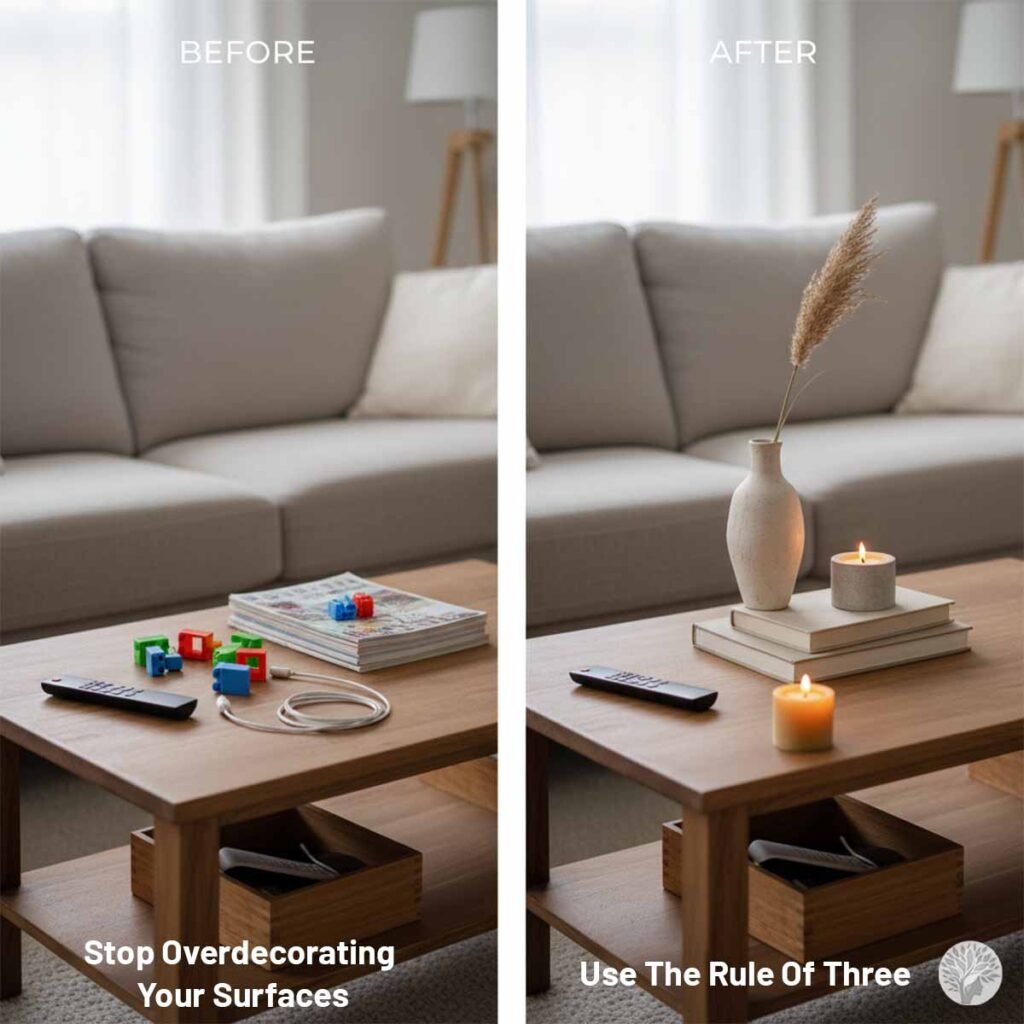
- The “One-In, One-Out” Rule: This is the golden rule of a visually quiet home. For every new decorative piece you bring into your space, one must be removed or moved to closed storage. This ensures your “visual volume” stays at a steady, manageable level rather than creeping up over time.
- The “Rule of Three”: Instead of a row of small items, try grouping three items of varying heights and leaving the rest of the surface completely bare. This creates a focal point that is easy for the brain to process.
The Mindful Shift
We must reframe how we see “emptiness.” A clear dining table is not “unfinished” or “waiting for a centerpiece.” It is an invitation for presence. It is a space ready for a deep conversation, a quiet cup of tea, or a moment of connection with your children. When you stop trying to “fix” the empty spaces in your home, you start finding more space in your mind.
Minimal Home Styling With Natural Textures
A common misconception is that a “visually silent” home must be a cold, sterile box. On the contrary, when we remove the “loud” items like the plastic bins, the busy patterns, and the high-contrast clutter we make room for the beauty of Texture.
In design, texture provides what I call “Quiet Interest.” It gives the eye something rich and beautiful to observe, but because it doesn’t involve a complex geometric pattern or a bright color, the brain doesn’t have to “work” to process it. Texture invites you to feel, whereas pattern forces you to think.
The Power of Sensory Anchoring
We spend so much of our lives touching glass screens and plastic keyboards, the materials that feel “dead” to our nervous systems. To create a truly calm home, we must replace these synthetic materials with grounding, organic elements. This is the practice of Sensory Anchoring using the physical world to pull your mind out of “screen fatigue” and back into the physical “now.”
Raw Wood As A Sturdy Anchor
Wood carries a sense of ancient, sturdy peace. Whether it’s a reclaimed oak coffee table or a simple cedar bowl, wood adds an immediate “weight” to a room that feels safe and grounded.
- The Mindful Detail: Notice the grain of the wood. It tells a story of growth and time, providing visual interest that is deeply soothing.
Linen And Cotton For Softening Hard Edges
Modern homes are full of “hard edges” such as plaster walls, glass windows, and metal appliances. Linen and organic cotton act as the “hush” for these surfaces.
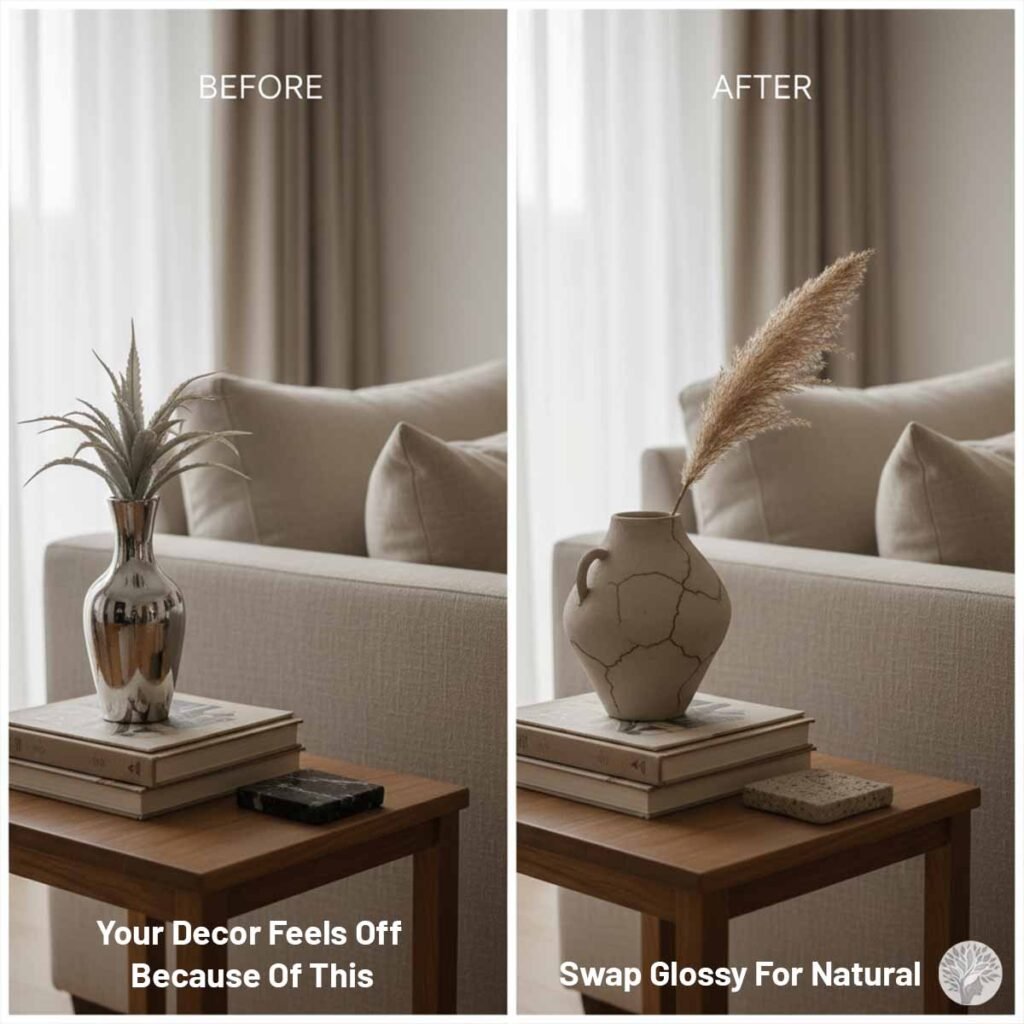
- The Action: Swap shiny polyester throws for heavy-weight linen cushions or a chunky knit cotton blanket. These materials diffuse light rather than reflecting it, which instantly lowers the “visual volume” of a room.
Greenery As The Breath Of Your Room
No element brings “Visual Silence” to life quite like Indoor Plants. They are the ultimate biophilic tool.
- The Action: Incorporate plants like the Snake Plant for its architectural strength or the Pothos for its soft, trailing movement. Plants don’t just purify the air; they provide a “living texture” that connects our indoor sanctuary to the natural world outside.
Clay And Stone For Earthly Connections
Materials like terracotta, matte ceramics, and natural stone connect the interior of your home to the earth.
- The Mindful Detail: A hand-fired clay vase has “imperfections” that make it beautiful. These subtle variations give the eye a place to rest and admire craftsmanship without the sensory overload of mass-produced, high-shine decor.
The Result as a Tactile Reset
Touching a cool stone coaster, running your hand over a grain-textured wooden table, or sinking into a linen chair acts as a Sensory Anchor. It interrupts the “scroll-and-click” rhythm of our digital lives. When your home is filled with natural textures, it stops being just a place you look at and starts being a place you experience with all your senses. This is where true domestic peace begins.
How Lighting Affects A Calm Home Environment
You can have a perfectly decluttered room, with every surface polished and every object in its place, but if you are using harsh, blue-toned overhead lighting, the space will still feel “loud.” Lighting is the invisible, yet most powerful, element of visual silence.
While furniture occupies physical space, light occupies the atmosphere. It dictates how your brain perceives color, texture, and even the “weight” of the objects around you.
The Science in Circadian Lighting
In the modern world, we are constantly bathed in “cool” blue light from our smartphones, laptop screens, and standard LED ceiling fixtures. This light mimics high-noon sunlight, telling our brains to stay alert, productive, and high-energy. When this light stays on after the sun goes down, it creates a biological “mismatch.” Your body knows it is evening, but your eyes are telling your brain it is midday.
This creates a state of internal “noise” that prevents you from ever truly winding down.
The “Golden Hour” Strategy as a Daily Ritual
To create a truly peaceful space, we must mirror the natural rhythm of the sun. This is the “Golden Hour” strategy of bringing the soft, amber glow of sunset into your home.
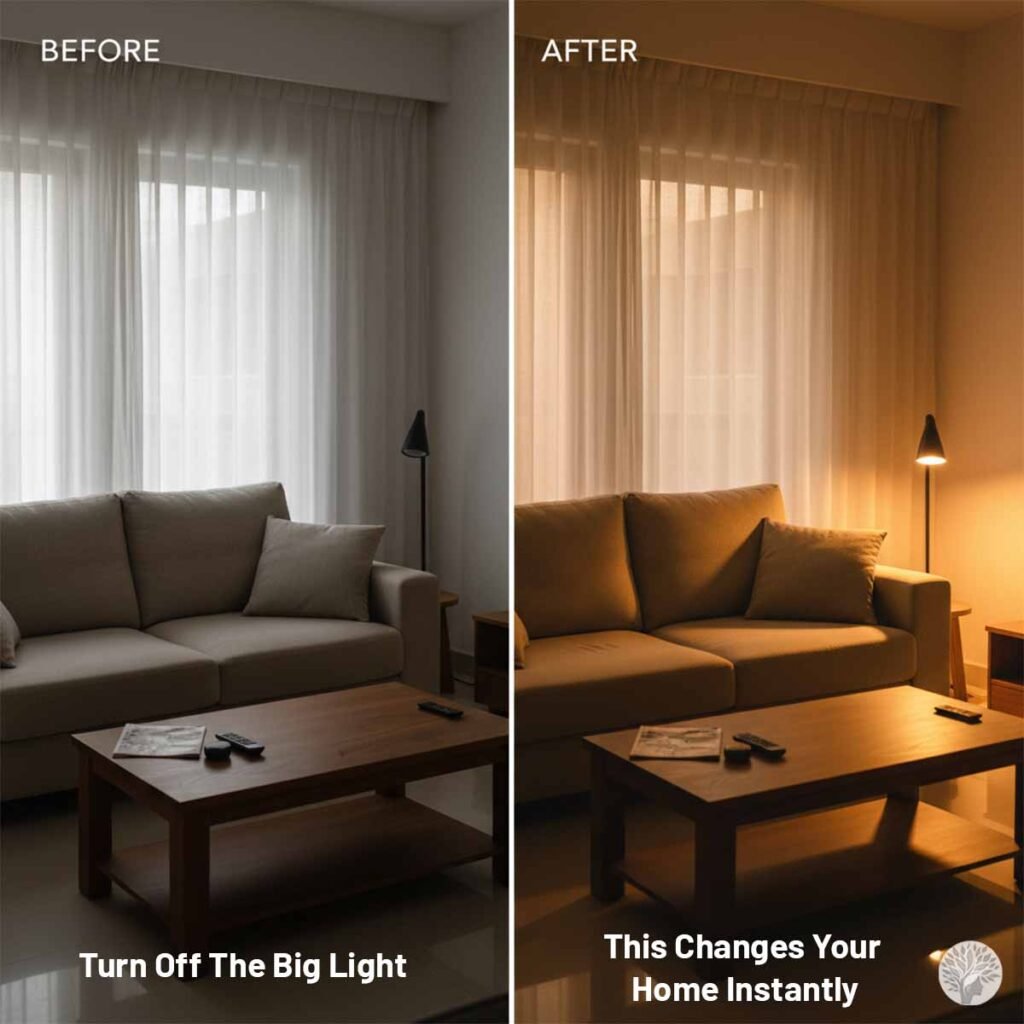
- The Action for Lowering the Volume: As the sun begins to set, switch off the “big” overhead lights. These lights cast harsh, flat shadows that highlight every imperfection and leftover piece of clutter in the room.
- The Use of Layered Warmth: Instead, rely on lamps with warm-toned bulbs (specifically 2700K on the color temperature scale).
- The Importance of Placement: Position these lamps at eye level or lower on side tables, floor stands, or mantels. When light comes from below eye level, it creates a sense of intimacy and security, much like sitting around a campfire.
The Effect in Soft Shadows and Gentle Transitions
The magic of warm, low-level lighting is that it creates Gentle Shadows. Unlike harsh overhead light that exposes everything, soft lamp light allows the corners of the room to recede into a quiet darkness.
- Hiding the Day: It subtly “hides” the remaining visual clutter of daily life like the stray toy or the stack of mail that you haven’t had a chance to put away.
- The Biological Signal: Most importantly, this amber glow signals to your pineal gland to begin producing melatonin. It tells your brain that the day is over, the “tasks” are finished, and it is finally time for the mind to settle.
Lighting as the Final Layer of Peace
By mastering your light, you aren’t just decorating; you are mood-setting. You are turning your home from a high-functioning “office of life” into a breathable sanctuary. It is the final, golden thread that weaves all your other efforts of the colors, the textures, and the empty spaces into a single, silent masterpiece.
A Room-by-Room Guide to Visual Silence
Creating a calm and peaceful home environment is a journey that starts the moment you turn your key in the lock. By treating each room as a specific “sensory zone,” you can manage the flow of energy throughout your day.
The Entryway as Your Decompression Chamber
The entryway is the most critical transition point in your home. It is the “airlock” between the loud, demanding outside world and your private sanctuary. If you walk through the door and immediately see a mountain of shoes, a pile of coats, and a stack of mail, your cortisol levels spike before you’ve even taken off your coat.
- The Strategy for Instant Calm: Move away from open shelving where every object is visible. Use closed baskets for shoes and a dedicated “one-touch” drawer or decorative box for mail.
- The Result in Your Mind: When the entryway is clear, your brain receives an immediate signal: The outside world is stayed at the door. You are safe. You are home. Your entry should act as a deep breath that says, “Welcome back to peace.”
The Living Room as Your Social Sanctuary
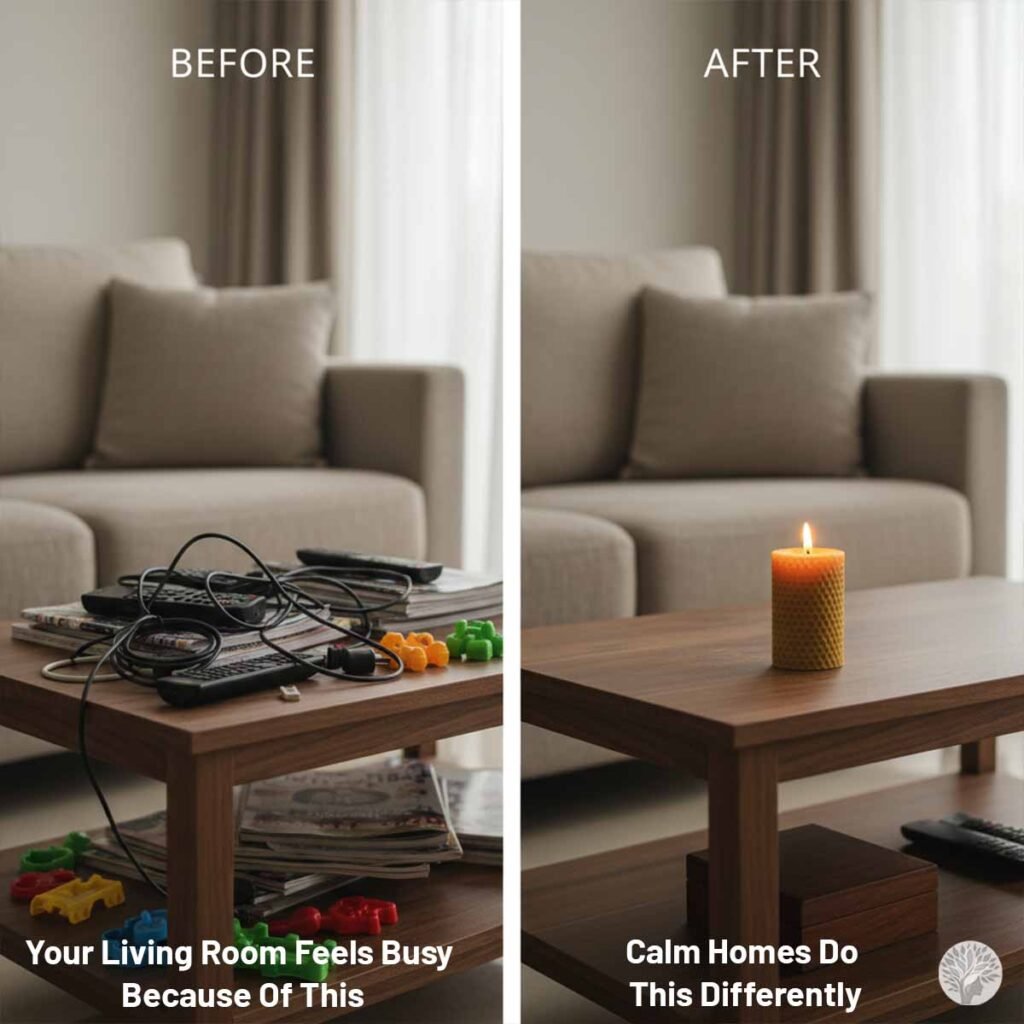
The living room is often the heart of the home, which means it is also the magnet for “logistical noise” of the remotes, charging cables, and scattered toys. To turn this into a social sanctuary, we must curate what the eye sees while we relax or connect with family.
- The Strategy for Visual Clarity: Keep the coffee table, the visual center of the room clear of everything except one “Soul Item.” This could be a single beeswax candle, a small bowl of smooth river stones, or a lone, beautiful art book.
- The Invisible Organization: Invest in a small wooden chest or a fabric-lined box to hide “utilitarian” items like remotes and chargers.
- The Result in Your Mind: By removing the “reminders of tasks” (like a messy pile of magazines or a tangled cord), you allow the room to focus on its true purpose: rest and human connection.
The Bedroom as Your Final Reset
Your bedroom should be the quietest “decibel” in your home’s visual symphony. This is where your nervous system performs its final reset for the day. If this room is filled with laundry piles, work laptops, or bright, clashing patterns, your brain will struggle to enter the deep theta waves required for restorative sleep.
The Result in Your Mind: When the colors of your bed match, the physical boundaries of the pillows and blankets seem to soften. The bed no longer looks like a “project” to be managed; it looks like a soft, inviting cloud. It provides a visual “hush” that prepares your mind for dreams.
The Strategy for a Soft Landing: Remove all electronics and “work-related” items from your line of sight. Embrace Tonal Bedding meaning choose a duvet, sheets, and pillows that exist in the exact same color family (such as soft ivory, charcoal, or sage).
“Invisible” Organization for Busy Moms
A happy, vibrant life naturally involves what I call “Logistical Noise.” This includes the essential but visually loud items of a modern household: colorful toys, school permission slips, charging cables, and half-eaten snacks. The goal of a mindful home is not to eliminate these items, but to make them Invisible the moment they are no longer in use.
When your brain can’t “see” the to-do list, it stops processing it as a task.
Tactile Storage as a Visual Buffer
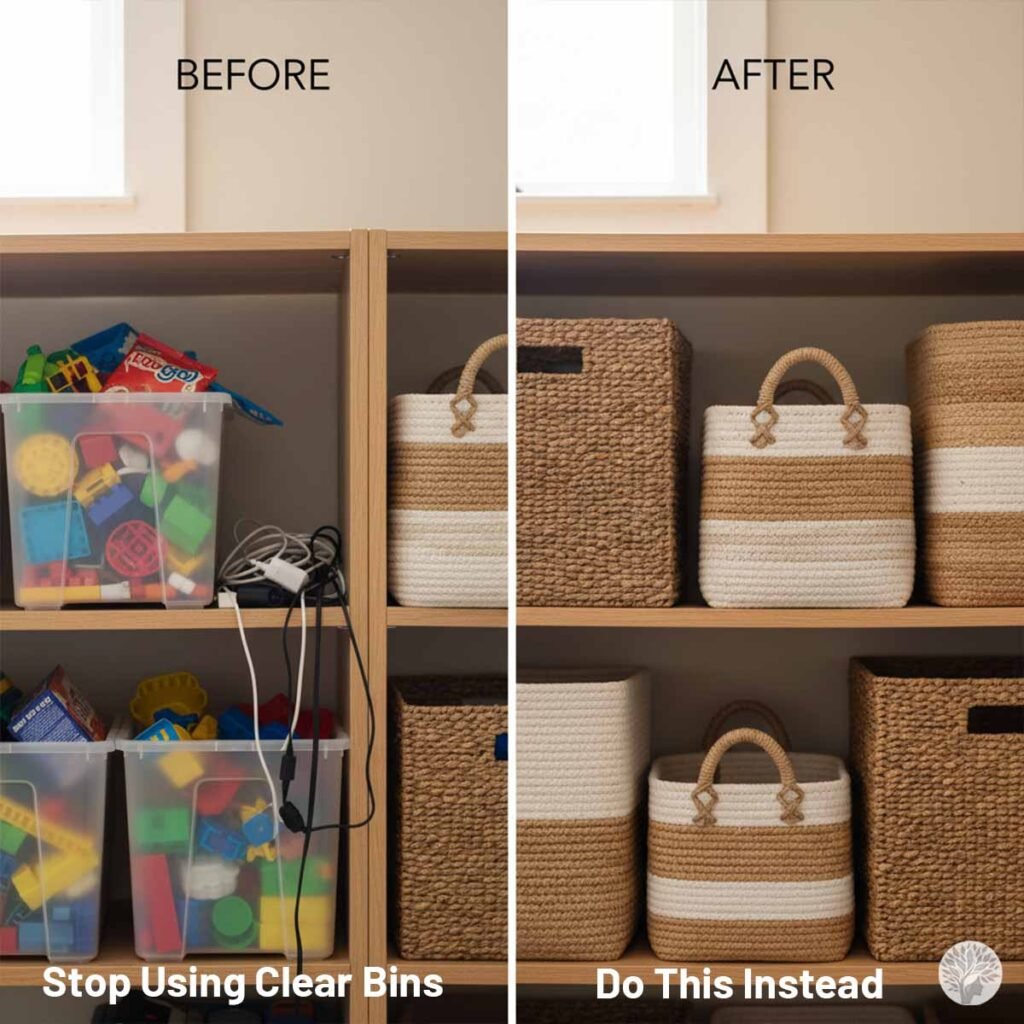
The most common mistake in home organization is using clear plastic bins. While they are functional for finding things, they are “visually loud” because you can see every mismatched color and shape inside them. This creates a “static” effect on your shelves.
- The Action for a Quiet Shelf: Replace clear plastic with Tactile Storage made up of woven seagrass, jute, or water hyacinth baskets.
- The Result in Your Mind: Natural fibers absorb light rather than reflecting it. When you tuck toys or papers into an opaque, textured basket, the “clutter” is replaced by a single, calming texture. You know the items are there, but your eyes are no longer forced to “sort” through them.
Closed Storage for “Silencing” the Room
Open shelving is beautiful in magazines, but in a busy family home, it often becomes a source of stress. Every object on an open shelf is a “word” your brain has to read.
- The Strategy of the Closed Door: Whenever possible, choose furniture with solid doors rather than glass or open slats.
- The Result in Your Mind: When you close the cabinet door on a stack of board games or a row of mismatched binders, you are literally silencing that part of the room. It is the architectural equivalent of a “hush.” It allows the room to return to its state of Visual Silence the moment the activity is over.
The One-Touch Rule for Paper Clutter
School papers and mail are the primary source of “surface noise” in most homes.
- The Action: Create a “Landing Zone” inside a closed cabinet or a beautiful wooden box. Instead of letting papers float across the kitchen island, they go directly into their “invisible” home.
- The Mindful Shift: By containing the logistical noise, you reclaim your surfaces for rest. You are teaching your brain that the “work” of the day has a designated place to live and it isn’t in your line of sight.
A Simple 3-Step Reset For Busy Days
If you feel overwhelmed right now, don’t try to fix the whole house. Perform this 5-minute visual reset:
- Clear One Visible Surface: Pick the kitchen island or the coffee table and clear it completely.
- Switch to Warm Lighting: Turn off the overheads and turn on a single lamp.
- Remove One Unnecessary Item: Find one thing that is “shouting” at you and put it in a drawer or a basket.
Mindful Home Design Is An Act Of Self-Care
Creating a peaceful space is not about perfection; it’s about intention. As mothers, we are often the “emotional thermostats” of our homes. By curating a calm and peaceful home environment, we are giving ourselves the gift of a regulated nervous system.
"When your home becomes visually quiet, your mind follows. And in that quiet, you find the space to lead a truly mindful life. And in that quiet, you will find yourself again."
Love ya, stay mindful!