
What is an Evening Reset Routine and how does it help you sleep better?
An Evening Reset Routine is a short, structured habit that helps your body shift from high cortisol to melatonin production, calming your nervous system and preparing you for deep, natural sleep.
What is an evening reset routine?
An evening reset is a 15-minute transitional habit designed to downshift your nervous system. It clears mental clutter and signals your body to move from the high energy of the day into a restorative state for sleep.
Hey Beautiful!
The laptop is finally closed, and the kitchen has settled into a rare moment of quiet. On the outside, everything looks peaceful. But inside, your brain is still running 50 background processes. You are physically still on the sofa, yet your mind is stuck in a frantic loop of today’s “to-do” list and tomorrow’s anxieties.
This is what I call Mental Tab Fatigue. It is the heavy, invisible exhaustion that comes from leaving too many cognitive windows open. When you don’t have a way to close these tabs, your brain stays in a state of high alert, making sleep feel like a chore you have to “achieve” rather than a natural rest you fall into. You aren’t just tired; you are overstimulated and untethered from the present moment.
An evening reset is your Threshold. In ancient architecture, a threshold was a sacred space between the chaotic outside world and the safety of the home. Your reset routine acts as that same intentional boundary between who you are during the working day, the fixer, the doer, the mother and who you are when you are at rest.
By creating a low-friction rhythm, you aren’t just sitting in the dark waiting for sleep to happen to you. You are actively inviting it. You are telling your nervous system that the “hunt” is over and the sanctuary is open. This is how you reclaim your evenings and replace the numbing midnight scroll with true biological peace.

The Science of the Downshift
We often treat our bodies like a light switch, expecting to flip from “Productive” to “Asleep” in seconds. In reality, your biology functions more like a dimmer switch. To experience deep, restorative sleep, we have to trigger specific physiological markers that move us out of the sympathetic nervous system (your fight-or-flight mode) and into a state of recovery.
- The Melatonin Signal – As the sun sets and light levels drop, your pineal gland (your sleep signal) begins its essential work of producing melatonin. This hormone is the conductor of your sleep-wake cycle, but it is incredibly sensitive to modern life. High-intensity blue light from your phone mimics the sun, tricking your brain into staying awake. By dimming your lamps and leaning into warmer tones, you protect this natural chemical production.
- The Cooling Effect – Your body temperature naturally drops as you prepare for rest. A warm shower or a cup of herbal tea actually aids this by triggering vasodilation (the cooling of your core body temperature). As the heat leaves your extremities, your internal “engine” cools down, which is one of the most powerful biological cues for the brain to initiate sleep.
- The Quiet Nerve – The most direct way to speak to your brain is through your breath. Deep, rhythmic breathing engages the parasympathetic nervous system (your body’s natural calm mode) via the vagus nerve. This is the physiological equivalent of hitting the “reset” button on your heart rate and blood pressure, signaling to every cell in your body that the day’s work is officially done.
The 15-Minute Reset Roadmap
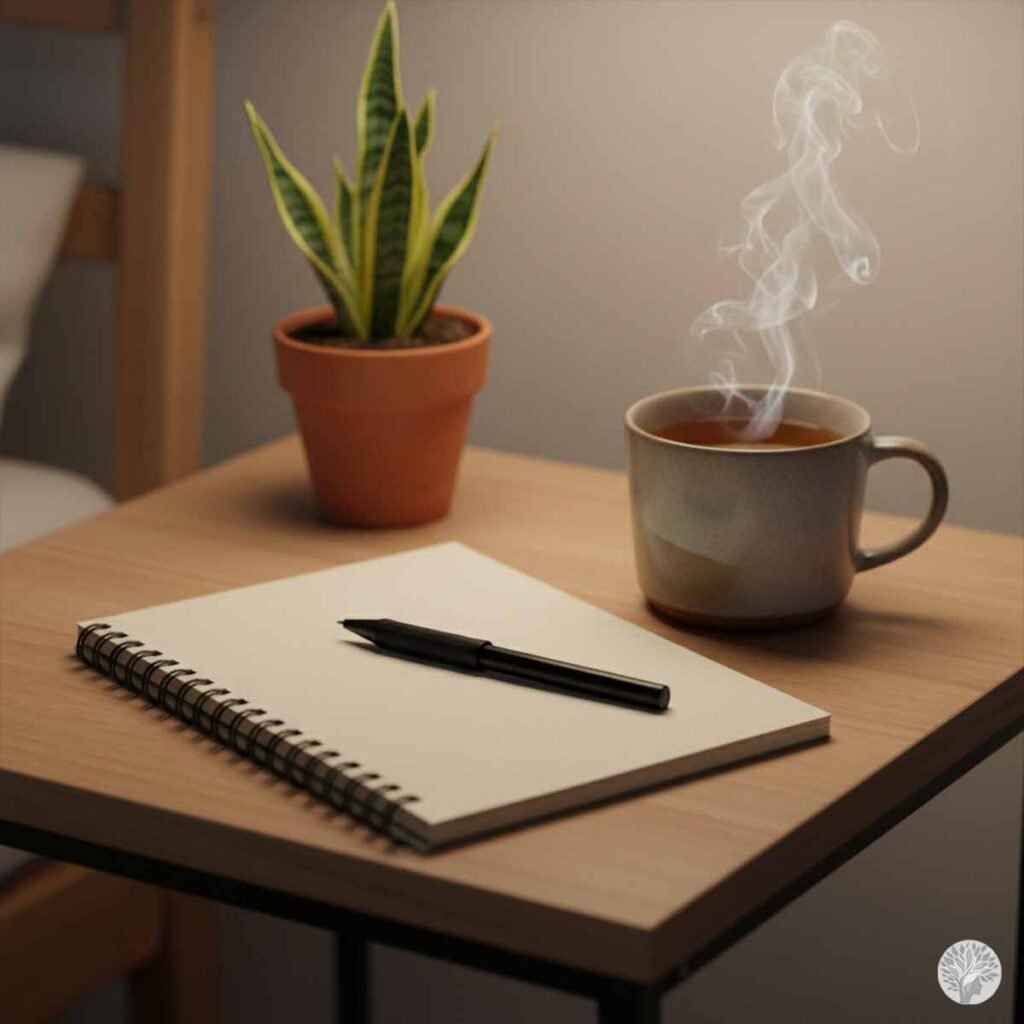
The most important rule of an evening reset is to keep it decision-free. At this hour, your “decision muscle” is exhausted. Do not turn your rest into a new project or a complex 10-step obstacle course. Instead, use these three 5-minute blocks to close the open loops of your day and prepare your body for the descent into sleep.
1. The Brain Dump (5 Minutes)
Grab a physical notebook, avoid your phone here and offload everything currently occupying your mental space. Write down your “Top 3” non-negotiable tasks for tomorrow and any lingering worries that are “looping” in your head.
- The Logic: This simple act of writing stops the Zeigarnik Effect (the brain’s tendency to obsess over unfinished tasks). When a task remains in your head, your brain uses active energy to ensure you don’t forget it. By putting it on paper, you provide your mind with “Cognitive Closure.” You are essentially telling your brain, “It is stored safely; you can let it go now.” This lowers your internal noise and prevents the 3:00 AM panic about a forgotten email.
2. The Sensory Shift (5 Minutes)
Move through your home and dim the overhead lights. Switch to warm-toned lamps, light a single candle, or use “amber” lighting. During this time, engage with your Meditation Plants. Reach out and touch the cool, thick leaf of your Aloe Vera or the sturdy edge of your Snake Plant as a tactile anchor.
- The Logic: This physical connection to your home sanctuary directly signals the limbic system (your emotional processing center) that the environment is secure. Your brain is hardwired to respond to sensory cues. While bright overhead lights signal “noon” and “productivity,” soft light and the touch of living nature signal “dusk” and “safety.” This shift tells your biology that you are no longer in “output mode” and are now moving into a state of personal sanctuary.
3. The Evening Descent (5 Minutes)
This is the final transition. Move into your bathroom for your simple skincare routine. As you cleanse your skin and massage your face, practice Box Breathing (a rhythmic breath pattern that settles the heart). Inhale for four counts, hold for four, exhale for four, and hold for four.
- The Logic: This combines physical hygiene with a total nervous system reset. By pairing a repetitive action (cleansing) with a structured breath, you engage the vagus nerve (the internal highway that controls your “rest and digest” mode). It turns a necessary, daily chore into a grounding ritual. As you wash away the literal dust of the day, the rhythmic breathing flushes out the residual adrenaline, ensuring you enter your bedroom with a heart rate that is steady and a mind that is quiet.
How To Start Today Without Overwhelm
The most common reason people fail at a new rhythm is that they try to do too much, too soon. You do not need a two-hour meditation practice, a sound bath, or an elaborate ritual to find peace. In fact, adding a complex routine to an already heavy schedule only increases your cortisol levels. You don’t need more “to-dos” you just need a consistent Boundary.
A boundary is a protective fence you build around your energy. It is the moment you decide that the world’s demands on you have officially ended for the day. Here is how to implement that boundary tonight, using three low-friction steps.
Park Your Phone
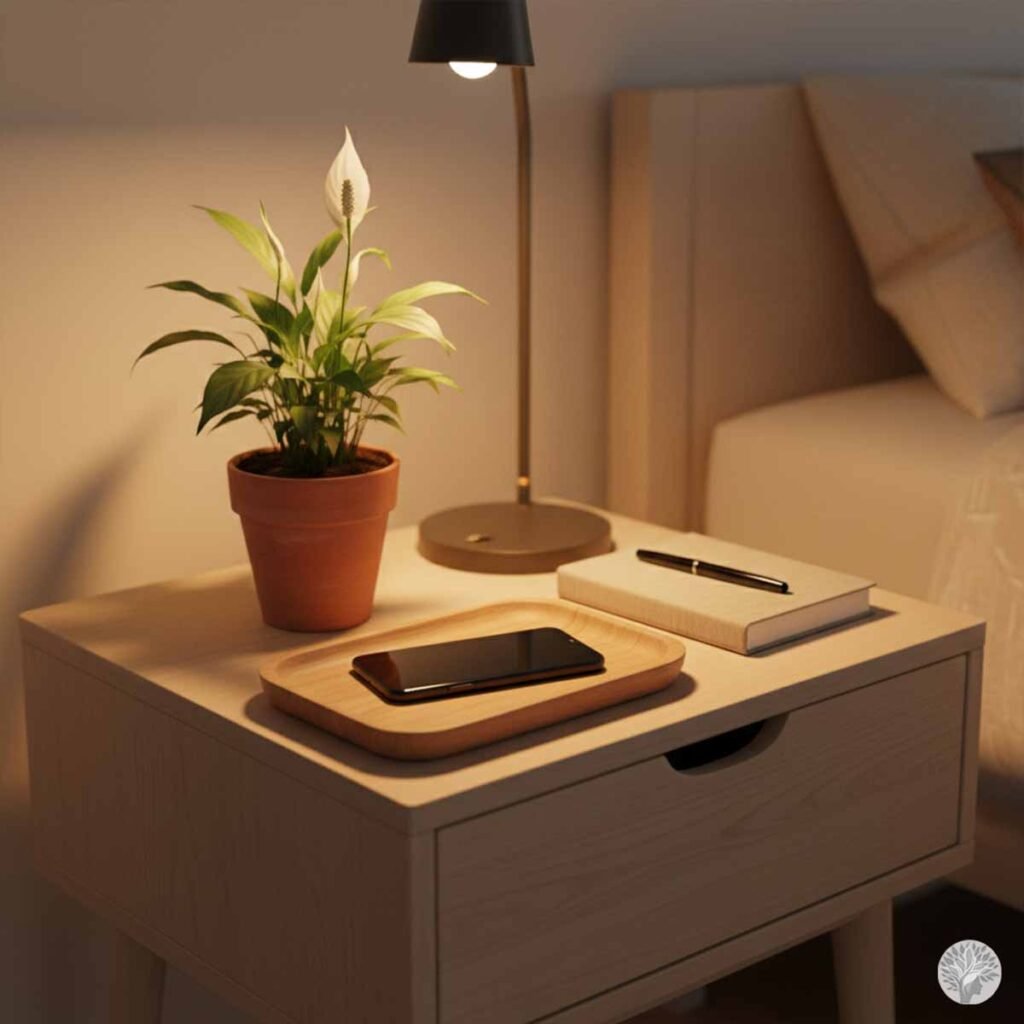
Choose a physical “parking spot” for your phone that is not in your bedroom. This might be a kitchen drawer, a charging station in the hallway, or a basket in the living room. Commit to placing it there at least 30 minutes before your head hits the pillow.
- The Deep Dive: Your phone is a portal to “Everywhere Else.” When it sits on your nightstand, your brain remains tethered to the office, the news, and the social expectations of others. By physically distancing yourself from the device, you stop the Digital Pavlovian Response (the urge to check for notifications). This simple distance allows your mind to return to its own “home base” and begin the natural descent into stillness.
Lower the Volume
Turn off the TV, silence the loud podcasts, and let the house settle into its natural evening hum. If you live in a noisy environment, consider soft white noise or a gentle hum of a fan.
- The Deep Dive: High-frequency noise keeps your Arousal Levels (your state of physiological alertness) elevated. By consciously lowering the decibels in your environment, you are signaling to your brain that there is no longer a need for “hyper-vigilance.” This auditory shift allows your thoughts to slow down, matching the quiet rhythm of your home sanctuary.
One Breath
Before you climb into bed, stand for just 30 seconds near your Snake Plant. Take three slow, deep breaths, consciously noticing the cool air entering your lungs and the warm air leaving.
- The Deep Dive: Because the Snake Plant is a CAM Plant (one that releases oxygen at night), the air in its immediate vicinity is literally fresher. This micro-moment of oxygenation serves as a biological “full stop” to your day. It is a physical anchor that transitions you from the “doing” of the evening reset to the “being” of sleep.
Start With One Small Thing
If 15 minutes feels like too much tonight, I want you to ignore the full roadmap and focus on just one thing. Perfectionism is the enemy of a calm home. Your nervous system doesn’t care about a “perfect” routine; it cares about safety and predictability.
Your Entire Job Tonight:
- The 30-Minute Gap: Put your phone away 30 minutes before you want to sleep.
- The 60-Second Dark: Once you are in bed, spend just 60 seconds in the dark, doing nothing but breathing.
That is it. You don’t have to “clear your mind.” You don’t have to feel “Zen.” You just have to be present. By successfully completing this one small thing, you are proving to your brain that you are capable of creating a sanctuary. Tomorrow, the 15-minute roadmap will feel like a natural next step rather than a daunting chore.
The Long-Term Benefit of the Reset
When you commit to this Evening Reset Routine For Calm Nights, you are doing more than just getting a better night’s sleep. You are actively rewiring your Neurobiology (the way your brain and nervous system interact). Over time, these small 5-minute blocks become a “Conditioned Trigger.”
Eventually, the moment you dim the lights or touch your plant, your parasympathetic nervous system will engage automatically. You will find that you fall asleep faster, stay asleep longer, and wake up feeling more emotionally resilient. This is the power of a home sanctuary. It is not a luxury, but a biological necessity for a mindful, centered life.
Common Mistakes to Avoid
The biggest mistake is expecting a perfect night after a chaotic day without a transition. Avoid “revenge bedtime procrastination” meaning the urge to stay up late because you did not feel in control of your day. Instead, use your reset to reclaim that control. Do not force a complex routine. If you only have two minutes, just do the Brain Dump.
Create a Mindful Night
Your evening reset is far more than a checklist; it is a profound act of Self-Respect. It is the specific moment in your day when you decide that your internal peace is more important than “one more email,” “one more video,” or one more minute of someone else’s demands. In a world that constantly asks for your attention, reclaiming your evening is a quiet form of rebellion.
By leaning into the Biological Blueprint (the natural rhythms of your own body), you are creating a reliable system that supports your mental health from the inside out. You aren’t just “trying to sleep” you are building a foundation of emotional resilience. When you honor your need for a threshold, you wake up the next morning as a version of yourself that is more present, more patient, and more centered.
Let’s Build Your Sanctuary Together
I know that every home has a different rhythm. Some nights are louder than others, and some “mental tabs” are harder to close than others. To help you find your unique flow, I would love to hear about your experience.
- The Daily Struggle: Do you find it harder to “turn off” your looping thoughts (the mental fatigue), or do you struggle more with the physical restlessness and “tired but wired” feeling of a high-energy day?
- The Weekly Challenge: I invite you to try this 15-Minute Reset Roadmap for just seven days. After one week, come back to this post and leave a comment. How did your body respond? Did the “Brain Dump” help you stay asleep, or did the “Sensory Shift” make your home feel more like a sanctuary?
Sharing your journey helps other mothers realize they aren’t alone in the “midnight hum” of a busy mind. Leave a comment below, and let’s discuss the specific anchors that are helping you reclaim your calm.
One breath and one boundary is enough to begin a mindful life.
Love ya, stay mindful!

Find Your Next Pocket of Calm
- 12 Homemaking Habits I’m Unlearning at 42 to Protect My Peace
- The Mindful Home Framework | The Master Guide for Busy Moms
- Mid Day Reset Routine to Close Mental Tabs and Regain Calm
- A Four-Phase Guide To Build A Mindful Home Routine
- Tired of the Chaos? Create a Calm Home Sanctuary That Heals Overwhelmed Moms