

Weekly Meal Planning for Moms is a simple system that pre-decides meals in advance, helping reduce decision fatigue, lower cortisol spikes, and create a calm, structured kitchen routine that saves time, energy, and mental load.
Hey Beautiful!
Imagine it is 5:00 PM. You are standing in the center of your kitchen, and suddenly, the world feels very “loud.” It isn’t just the noise of the kids asking about dinner for the third time. It’s the sensory weight of the day finally catching up to you. The overhead light, which felt fine at noon, now feels sharp and intrusive against your tired eyes. You open the fridge, and instead of seeing the ingredients for a meal, you see a chaotic puzzle of half-full jars and mismatched produce that you simply don’t have the energy to solve.
In this moment, your body is physically present, but your mind has officially “checked out” for the day. This isn’t because you are disorganized or incapable; it is because you have hit the invisible wall of the “mental load”. As a mother, you spend your entire day managing a million tiny details for everyone else, and by the time evening rolls around, your internal battery is drained.
The Weight of the “Open Question”
The hardest part of 5:00 PM isn’t actually the cooking, it’s the decision. When you don’t have a plan, “What’s for dinner?” stays like an open tab in the back of your brain from the moment you wake up until the moment food is finally on the table. That “open tab” uses up your patience and your peace.
You don’t need a complicated, five-star recipe or a culinary challenge that requires more of your dwindling energy. What you actually need is direction. You need a pre-drawn map that tells you exactly where to go so you don’t have to think your way through the fog of exhaustion.
Setting a Boundary for Your Peace
An evening meal plan is more than just a list of food; it is a way of pre-deciding your nutrition so you can opt-out of “Decision Fatigue” when you are at your most vulnerable. It acts as a protective boundary for your mental well-being. By taking the guesswork out of the evening, you are ensuring that your kitchen remains a sanctuary a place where you can breathe and reconnect rather than a source of frantic, end-of-day stress.
Planning is a quiet gift you give to your “5:00 PM self,” allowing her to move through the evening with a sense of rhythm rather than a sense of panic.
The Hidden Science of the 5 PM Slump
By the time evening rolls around, your brain is already deeply tired. Since the moment you woke up, you have made thousands of micro-decisions that have slowly chipped away at your energy: What should the kids wear? Is it a PE day? Did I reply to that email? What is that smell in the pantry? This is exactly why choosing between pasta or dal at 5:00 PM feels like a monumental task. It isn’t a lack of cooking skill or a failure of character; it’s a biological depletion of your cognitive resources.
Understanding Decision Fatigue
In Environmental Psychology, we acknowledge that willpower and decision-making are finite resources. Think of your brain like a phone battery. You start the morning with a full 100%, but every small choice even the ones you don’t realize you’re making drains a small percentage of that power. By 5:00 PM, you are operating on 5% power, yet you are asking your brain to perform high-level logistics and creative problem-solving. When you have no plan, you are forcing an exhausted system to run a “heavy app” when it is desperately trying to enter power-save mode.
The Cortisol Spike
Uncertainty in the kitchen does more than just annoy you; it triggers a physical, low-level stress response. When the brain perceives a “problem” it can’t immediately solve like a hungry family, a messy counter, and no plan, it releases cortisol, your primary stress hormone.
This elevation in cortisol often leads to “emergency ordering” or stress-eating as your body looks for a quick hit of energy to handle the perceived crisis. This ultimately disrupts your glucose stability, leading to a spike and then a crash that leaves you feeling even more depleted, irritable, and physically worn out.
Closing the Mental Tabs
I often talk about Mental Tab Fatigue that heavy, cluttered feeling of having too many “cognitive windows” open at once. For many moms, “What’s for dinner?” is a tab that stays open and running in the background from 10:00 AM until the moment food actually hits the table. It is a constant hum of low-grade anxiety that drains your focus throughout the day.
By planning your meals, you are “closing the tab” early in the week. You are freeing up that precious mental energy for more important things, like being present with your family or actually enjoying your evening.
A Mindful Reminder: You are not disorganized; you are overloaded. Planning is not a chore to add to your list; it is a profound gift of peace you give to your future self.
The 3-Step Low-Friction Framework
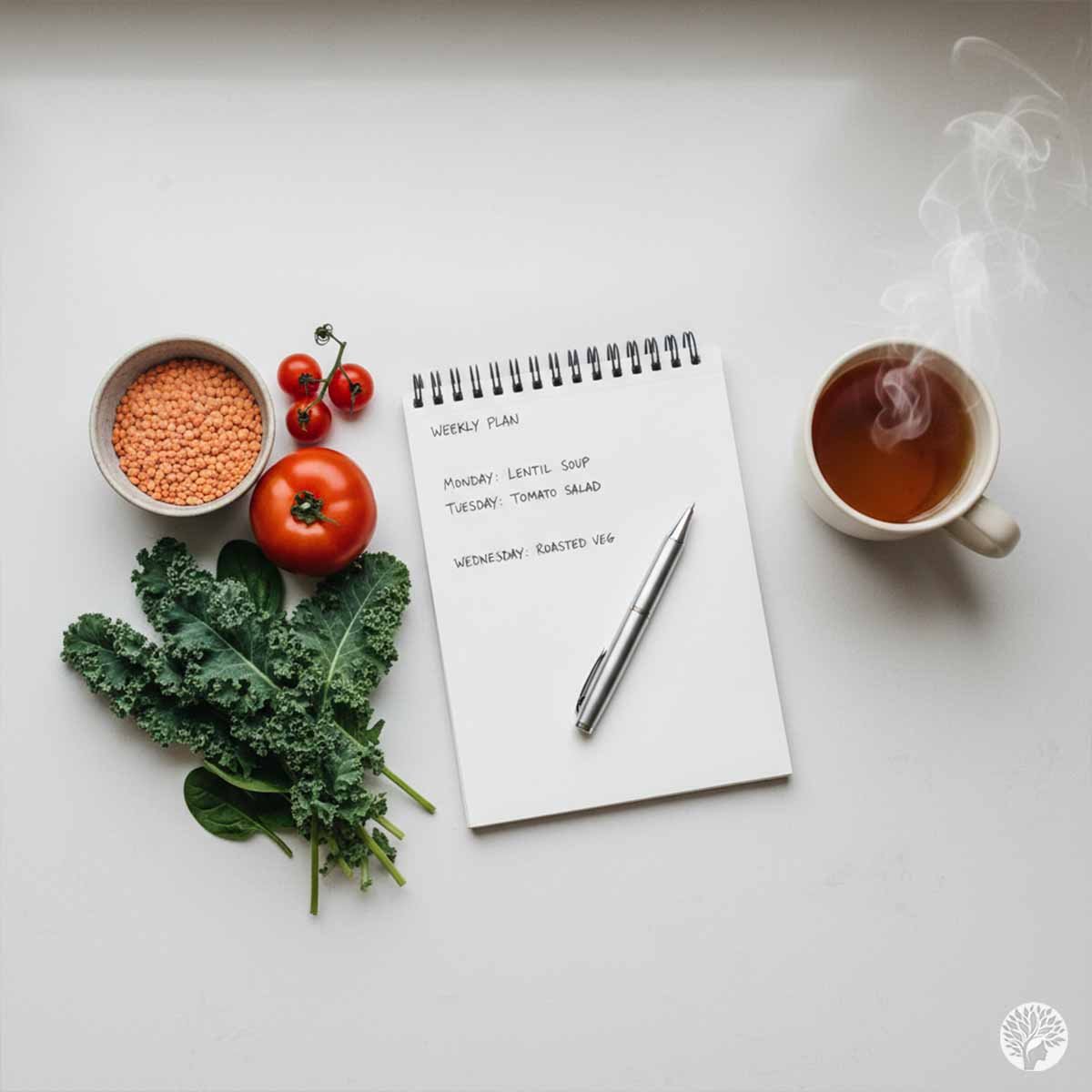
You don’t need more recipes; you need fewer decisions. The goal here isn’t to curate a 5-star menu every night; it is to create Visual Silence in your schedule. When your calendar is quiet, your mind can be, too.
To achieve this, we use a low-friction approach that works with your tired brain, not against it.
Step 1: The Inventory Reset (5 Minutes)
Before you even think about opening a grocery app or flipping through a cookbook, I want you to find your Anchor Surface. This is that one specific, clear spot on your kitchen counter that you have designated as “clutter-free.” Stand there, breathe, and then look at your pantry.
- The Action: Quickly note 2–3 items you already have. Maybe it’s half a bag of red lentils, a box of pasta, a forgotten jar of pesto, or a bag of frozen peas tucked in the back of the freezer.
- The Logic: Starting from a “blank slate” is one of the most intimidating things you can ask a tired brain to do. It’s why we stare at the fridge and see nothing. By finding those first two items, you are giving yourself a head start. This provides your mind with Cognitive Closure the satisfying feeling of finishing something or putting a puzzle piece in its place. You aren’t “cooking from scratch”; you are simply completing a meal that has already begun.
Step 2: The Theme Strategy
This is the strongest hook in your arsenal because it removes the “anything in the world” pressure. Instead of choosing from an infinite list of possibilities, you choose from a narrow category.
- Monday: The Comfort Start (Simple Dal & Rice) – Keep the beginning of the week predictable, grounded, and deeply nourishing.
- Tuesday: Taco/Wrap Night – High customization, low effort. Everyone builds their own, and the prep is minimal.
- Wednesday: The One-Pot Reset – By mid-week, energy usually dips. A single pot means minimal cleanup and a quicker path to the couch.
- Thursday: Grain Bowls/Salads – This is the day to use up the fresh produce before it has a chance to wilt.
- Friday: The “Leftover” Buffet – Clear the fridge before the weekend. It’s a sustainable way to honor the food you’ve already prepared.
The Logic: Themes remove 80% of the choices. You aren’t asking, “What should I cook?” which is an open-ended, exhausting question. Instead, you’re asking, “Which one-pot meal should I make?” This narrows your field of vision, making the decision-making process manageable and almost automatic.
Step 3: The Grocery Slot
A plan is only as good as the ingredients actually sitting in your house. To avoid the “missing ingredient panic,” you must schedule your stocking.
- The Deep Dive: Whether it’s a Saturday morning market run or a Sunday night online order while you sit in bed, you must link this habit to a specific time. When you shop with a list based on your Themes, you stop “aspirational buying” that habit of buying kale you’ll never massage or exotic sauces you don’t have a use for.
By only bringing in what fits your plan, you drastically lower the Visual Noise inside your fridge. Every time you open that door, you see a clear path forward instead of a jumble of “to-do” tasks masquerading as groceries.
The “10-Minute Emergency Plan” (For the Overwhelmed Mom)
There are weeks when even a three-step framework feels like one step too many. Maybe the toddler is teething, work is peaking, or you’re simply in a season where your “mental battery” isn’t just low, it’s empty. In these moments, I want you to give yourself permission to ignore the “perfect” version of planning. We are moving away from “optimal” and moving toward “survival with soul.”
If you are currently in that space, use this “No Plan” Plan:
- Pick 3 Meals: Just three. Don’t worry about the other four days of the week. Don’t worry about variety or trying something new. Pick three things you can cook with your eyes closed, the meals that feel like a warm hug.
- The Power of Repetition: Eat them twice this week. Monday/Wednesday and Tuesday/Thursday. This isn’t “boring”, it’s efficient. By cooking once and eating twice, you are literally cutting your evening workload in half. You are buying back three hours of your life.
- Write the List & Stop: Get those specific ingredients and nothing else. That is your entire job tonight. You aren’t “planning a week”; you are simply securing three windows of peace.
When Even Three Decisions Feel Like Too Much
There are evenings when your brain hits a total “Error 404” screen. You are staring at a bag of pasta and a jar of marinara, and even the simple process of boiling water and opening that jar feels like a complex logistics project you just cannot manage. If picking those three meals still feels like it’s asking too much of your cognitive battery, stop. Take a deep breath. You don’t need to be a chef right now; you just need to be a Facilitator of Peace.
In these moments of total paralysis, we often turn to our phones for inspiration. But scrolling through thousands of “quick” recipes on Pinterest or Instagram actually does more harm than good, it adds more Visual Noise to an already loud mind. You don’t need more options; you need the absolute opposite. You need a single, clear exit ramp from the stress.
The Power of Outsourcing the Logistics
When you find yourself in this state of “paralysis by analysis,” the goal is to outsource the heavy lifting of “figuring it out” to a pre-set system. By following a rigid, simple path, you remove the Cognitive Load entirely. You move from the stressful position of being a “Fixer” (the person who has to solve the dinner problem for everyone else) to a “Rhythmic Mover” (the person who is simply following a pre-existing prompt).
This shift is vital for your mental health at 5:00 PM. It allows you to close that “Mental Tab” that has been draining your focus all day. When the decision is already made or narrowed down to a single path you stop fighting the fog of exhaustion and start moving through it.
Your “Emergency Movement” Framework
When you are truly stuck, I want you to look at your Inventory Reset items and pick just one physical movement. Don’t think about the recipe; think about the method:
- Can I boil it? (Pasta, rice, or grains)
- Can I roast it? (Vegetables or proteins on a single sheet pan)
- Can I wrap it? (Tortillas, bread, or lettuce leaves)
Choose one method and add one sauce. That is your entire meal. By limiting yourself to these three basic movements, you create an immediate sense of Cognitive Closure. You have solved the puzzle without draining your remaining 1% of energy.
The goal here isn’t just to get food on the table, it’s to turn the looming, heavy question of “What’s for dinner?” into a calm, definitive “Dinner is decided.” This allows you to move through your kitchen with a sense of rhythm and ease, protecting your evening sanctuary from a sense of panic.
The Stress-Free Grocery Connection
The way we stock our kitchens is the foundation of our mental peace. We often think of the pantry as just a storage space for food, but in reality, it is a sensory environment that either supports your calm or contributes to your chaos. If your pantry is a jumbled collection of half-open bags, toppled boxes, and expired cans, your brain will perceive “noise” every time you open the door. This is what we call Visual Static. It’s a form of environmental stress that signals to your mind that there is more work to be done, even before you’ve started cooking.
To turn your pantry from a source of friction into a supportive tool, we focus on creating Visual Silence through three simple organizational shifts:
Group by Function (The “Logic of Use”)
Instead of organizing by size or brand, organize by how you actually move through a meal. Keep all your grains together in one zone, all your spices in another, and most importantly keep all your “emergency” items in a designated Rescue Zone.
- The Action: Create a shelf or a basket specifically for those items that require zero thought: pasta sauce, canned beans, pre-washed grains, or a high-quality jar of curry paste.
- The Logic: When you are in the middle of a “5:00 PM wall” moment, you don’t want to hunt through the back of a deep cabinet for a can of chickpeas. By grouping these together, you are reducing the Search Cost for your brain. You know exactly where the “peace” is kept.
The Clear Container Effect
While it is certainly not a necessity for a functional kitchen, moving your daily staples like rice, lentils, or flour into clear jars provides an immediate sense of Visual Silence.
- The Benefit: There is a profound psychological benefit to being able to see exactly how much you have at a glance. It prevents that sudden “Do we have enough rice?” panic that often leads to over-buying or last-minute grocery runs. When your ingredients are visible and tidy, the information is processed by your brain instantly, without you having to dig through crinkly, opaque packaging. It replaces a “question” with an “answer.”
The “One-In, One-Out” Rule
To keep your kitchen from becoming over-cluttered and visually overwhelming, try to adopt a strict boundary for your storage. Every kitchen has a natural capacity; when we ignore that capacity, we create Environmental Debt.
- The Action: Only buy what actually fits in your designated zones. If your spice rack is full, you don’t need a new “experimental” spice until one is used up.
- The Logic: This rule helps you stop Aspirational Buying, the act of buying ingredients for a version of yourself that has more time and energy than the person standing in the kitchen right now. By keeping your inventory lean, you are protecting the physical and mental space of your home, ensuring that your kitchen remains a Sanctuary rather than a storage unit for future chores.
What Changes When You Plan? (The Ripple Effect)
When you move from “Panic Cooking” to “Mindful Planning,” the atmosphere of your home shifts in ways you might not expect. It isn’t just about the food on the table; it’s about the energy in the room.
- Less Stress at 5 PM: You reclaim about 30 minutes of mental peace every single evening. That adds up to 3.5 hours a week of “found time”, the time you aren’t spending scrolling through delivery apps in a daze or staring blankly into the pantry.
- Fewer Takeout Decisions: You stop spending money on food born from exhaustion. When the plan is already there, the temptation to “just order something” fades because the path to a home-cooked meal is now the path of least resistance.
- Calmer Kitchen Environment: Because you know exactly what needs to happen, your physical movements in the kitchen become more rhythmic and less frantic. Your kitchen remains a Sanctuary of nourishment rather than a high-friction workspace.
- More Control: You move from being a “fixer” who is constantly putting out fires to a “facilitator” of your family’s well-being. This shift in roles reduces your overall Mental Load, allowing you to lead the evening with patience rather than panic.
- Glucose Stability: When you plan, you are far less likely to reach for high-sugar, highly processed “quick fixes.” This protects your body from the energy crashes and mood swings that follow a sugar spike, keeping your physical and emotional energy steady until bedtime.
Creating Your Mindful Kitchen Anchor
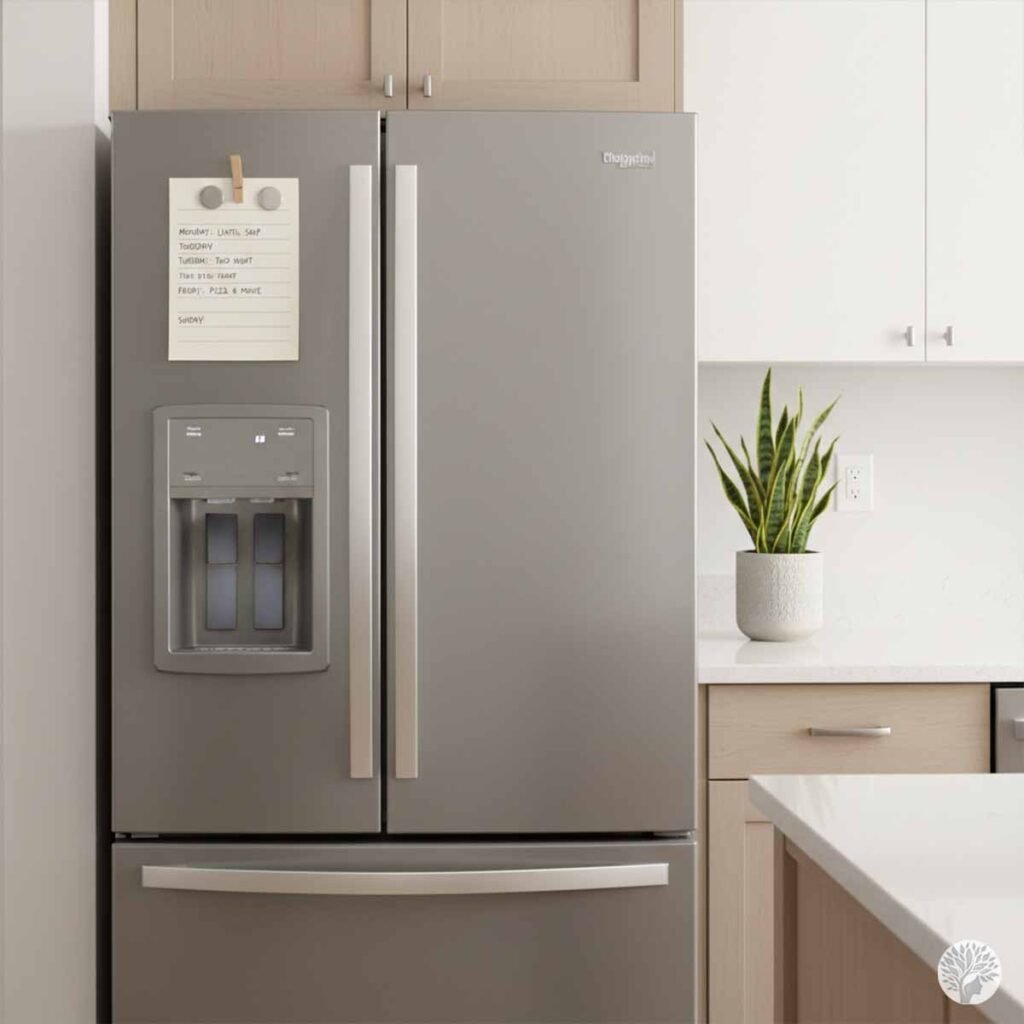
To make this new rhythm stick, you must move the plan out of your mind and into the physical world. You need a Visual Anchor.
Keeping a meal plan in your head is like leaving a heavy background app running on your phone. It’s just another “open tab” draining your battery while you try to focus on other things. By writing it down, you are practicing Cognitive Offloading. You are taking that mental weight and placing it onto a surface that doesn’t require your energy to maintain.
The Action: Externalize the Plan
Whether you use a small chalkboard, a printed template, or a simple dedicated notebook, place it on your fridge or your designated Anchor Surface. This becomes the “single source of truth” for your home.
When the plan is visible, it stops being a “guess” and starts being a “fact.” This visibility creates Environmental Support. Your kitchen is now actively helping you remember your intentions rather than asking you to recall them through a fog of exhaustion.
Protecting Your Vocal Energy
There is a hidden benefit to the Visual Anchor that every mother will appreciate: it protects your patience. When the kids (or your partner) ask, “What’s for dinner?” for the fourth time, you don’t even have to use your voice. You don’t have to search your memory or engage in a back-and-forth discussion that drains your dwindling reserves. You can simply point to the plan. This small, silent shift protects your vocal energy and keeps your frustration levels low. It turns a potential moment of friction into a moment of rhythmic ease.
Your Journey Starts Tonight
Ready to reclaim your kitchen sanctuary? You don’t need a massive overhaul to change the energy of your evenings; you only need to take the first step toward a low-friction rhythm.
- Tonight: Take just 60 seconds to look in your pantry. Don’t organize, don’t clean. Just find your 2 “Inventory” items. That’s your head start for tomorrow.
- Tomorrow: Pick just one “Theme” for the week. Let that single category filter out the noise of infinite possibilities.
Dinner is no longer a looming question that demands your last 1% of energy. It becomes a rhythm, a predictable, grounding part of your day that serves you as much as it serves your family.
I want to hear from you: Do you struggle more with the “What to cook” decision-making process, or is the “Getting the groceries” logistics the part that feels heavy? Leave a comment below, and let’s discuss how to simplify your week together.
QuoteFinding peace in the kitchen begins when you trade the chaos of choice for the rhythm of a mindful plan.
Love ya, stay mindful!