
Disclaimer: This post contains affiliate links for tools I’ve carefully curated or used in my own sanctuary; I may earn a small commission at no extra cost to you. Read my full disclosure.
Hey Beautiful!
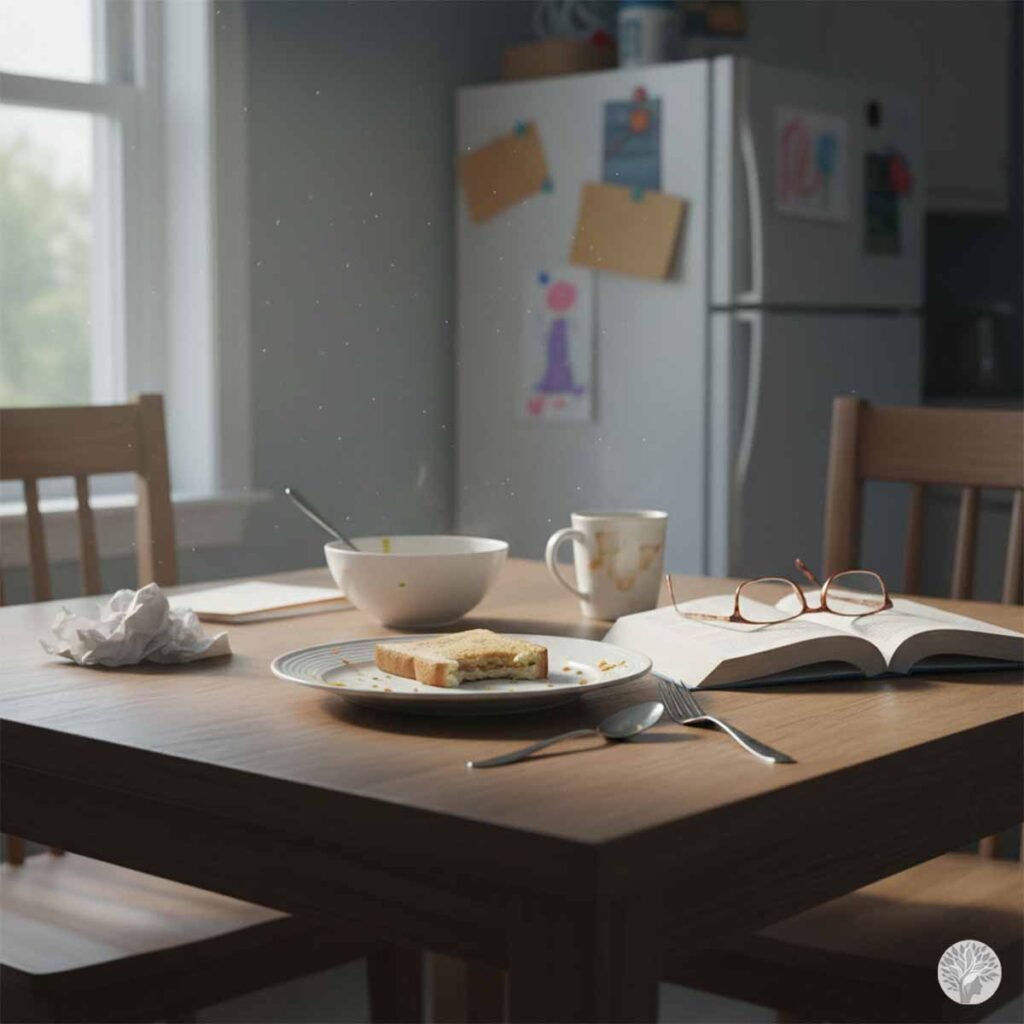
We’ve all been there. It’s 2:00 PM. The kitchen counter is covered in the remains of lunch, a repeated question is ringing in your ears for the tenth time, and you feel that familiar tightness in your chest. In that moment, you aren’t “parenting” anymore, you are just managing a series of small fires.
We often think mindful parenting means being a “Zen Parent” who never loses their cool and speaks in a whisper. But for most of us, that is a myth that only adds to our guilt. If you can’t achieve “perfect peace” while your toddler is having a meltdown, you feel like you’ve failed.
True mindful parenting isn’t about being perfect. It’s about Messy Mindfulness. It’s the ability to notice when you’ve lost your center and having a clear, simple path to find your way back. It’s realizing that you don’t need to control your child’s every move. You just need to slow down your own response. It is a commitment to the process, not the perfection.
What Is Mindful Parenting?
At its heart, mindful parenting is the practice of pausing before reacting.
Most of the time, we live in a state of reaction. A child spills the milk; we sigh loudly. A sibling fight breaks out; we snap. We are on autopilot, driven by exhaustion and habit. Mindful parenting creates a tiny “gap” between the event and your response.
In that gap, you find your power. It is the shift from reacting out of habit to responding with intention. This is what we call your Emotional Architecture, meaning the way you build your internal world so that the external noise doesn’t knock you over. You aren’t just “getting through the day”, you are responding to it.
Why Midday Feels So Hard
There is a biological and psychological reason why the hours between lunch and dinner feel like a steep uphill climb. If you find yourself losing your patience more often at 3:00 PM than at 9:00 AM, it isn’t because you are a “bad mom”. It’s because you are navigating a perfect storm of depleting resources.
In the Hetal Method, we look at three specific factors that create this midday friction:
- The Decision Fatigue Peak: By mid-afternoon, you have already made hundreds of micro-decisions. What’s for lunch? Did they wear socks? Why is the dog barking? Your brain’s ability to regulate emotions is like a battery, and by midday, that battery is in the “red zone.”
- Sensory Overload: In a busy home, the noise floor rises as the day goes on. The hum of the dishwasher, the TV in the background, and the constant “Mom, look!” create a sensory stacking effect. Your nervous system begins to stay in a state of high alert, making you more likely to snap at a minor spill.
- The Energy Gap: This is the physiological “slump.” Your morning adrenaline has faded, and the gap between your responsibilities and your remaining energy starts to widen.
When we understand that this overwhelm is a physiological response, we can stop blaming ourselves and start using tools to manage the environment.
The Power of the Pause
If mindful parenting has one “secret sauce,” it is the Pause.
When a trigger happens like juice hitting the rug or a sibling argument over a toy, your brain’s limbic system wants to react instantly. This is your “survival” brain. It views the spilled juice as a threat and prepares you to fight (yell) or flee (shut down). This is the Management Trap in action. You are reacting to the mess rather than the child.
The Pause is a three-second window where you choose to stay in your “thinking” brain. By taking just one intentional breath before you speak, you are rewiring your Emotional Architecture. You are telling your nervous system, “This is not an emergency. I am safe. I can choose how to show up here.”
This tiny gap is where your freedom lives. It is the difference between a midday that leaves you exhausted and one that leaves you feeling capable.
5 Simple Practices for Adaptive Presence
Understanding the science of the pause is the foundation, but the true transformation happens in the application. These five practices are designed to be used in the middle of the “high-friction” hours when the noise is loud and your energy is low.
We don’t ask you to step away into a quiet room or light a candle to find peace. Instead, we use Adaptive Presence to integrate mindfulness directly into the chaos of the kitchen, the playroom, and the hallway. Think of these as “micro-interventions” for your nervous system. They are short, physical, and designed to help you stay grounded so you can lead your family with calm authority rather than reacting from a place of depletion.
Practice 1: The Eye-Level Connection
One of the fastest ways to de-escalate a high-friction moment is to change your physical perspective. When we stand over our children and speak downward, we inadvertently trigger a “threat” response in their small nervous systems and often in our own.
The next time you feel the urge to yell across the room or handle a conflict from the kitchen doorway, try this: Get low.
Drop to your knees or sit on the floor so that your eyes are level with theirs. This simple shift does two powerful things:
- It regulates your body: The act of physically lowering yourself forces a brief pause in your momentum.
- It signals safety: At eye level, you are no longer a looming figure of authority; you are a present, grounded parent.

From this position, even a correction feels like a connection. You can say, “I see you’re having a hard time with that toy,” instead of “Put that away now!” This isn’t about being “soft”, it’s about being effective. When you connect before you correct, your child is much more likely to actually hear what you’re saying.
Practice 2: Sensory Grounding in the Kitchen
The kitchen is often the “command center” of midday overwhelm. It’s where the dishes pile up, the snacks are prepped, and the mental load feels heaviest. However, you can flip the script and turn these chores into a form of Messy Mindfulness.
Instead of viewing the soapy water or the vegetable chopping as a hurdle to get over, use them as a sensory anchor.

- Feel the water: Notice the temperature of the dishwater on your skin.
- Listen to the rhythm: The sound of the knife on the cutting board or the hum of the fridge.
- Create Visual Silence: Even if the whole house is messy, try to clear just one small square of the counter.
By focusing entirely on the physical sensation of the chore for just sixty seconds, you give your brain a Neurological Reset. You are no longer “managing” a kitchen. You are simply experiencing the present moment. This practice allows you to finish the task feeling more centered rather than more depleted.
Practice 3: Pause Before You Answer
We often underestimate how much our own verbal speed contributes to the house’s “noise level.” When a child asks a repetitive question or begs for a snack while you are mid-task, the habit is to snap back an answer immediately. This rapid-fire exchange keeps your nervous system in a state of high alert.
Try the Three-Second Buffer.

When you are asked a question, consciously wait three seconds before responding. During those seconds, take a shallow breath and soften your shoulders. This isn’t about ignoring your child; it’s about Adaptive Presence. It allows you to move from a “reactive” state into a “responsive” one. By slowing down your speech, you subtly signal to the entire room that there is no rush, no emergency, and no need for high-decibel energy. You are modeling the exact calm you want your children to mirror.
Practice 4: Validate Then Correct
In the heat of a midday tantrum or a sibling squabble, we often jump straight to the “correction”, the “Stop that!” or the “Go to your room!” However, when a child is emotionally dysregulated, their “thinking brain” is offline. Logic won’t reach them until they feel safe.
This practice is about building a bridge of Emotional Architecture through two simple steps:

- Validate: Name the feeling. “I see you are feeling very frustrated that the tower fell over.” This tells the child they are seen, which begins the process of calming their nervous system.
- Correct: Once the energy has shifted slightly, then you set the boundary. “But we cannot throw the blocks. Let’s pick them up together.”
When you validate first, you aren’t agreeing with the behavior; you are acknowledging the human being in front of you. This prevents the “Management Trap” where we only see the problem and forget the person. It keeps you grounded in your role as a guide rather than a referee.
Practice 5: The Afternoon Micro-Anchor
If the Morning Anchor is about setting your foundation, the Afternoon Micro-Anchor is about checking the structural integrity of your peace. Usually, around 3:00 PM or 4:00 PM often called the “Witching Hour” the collective energy of the home begins to fray. Instead of bracing yourself for the chaos, we use a micro-anchor to pivot.
This is a 30-second ritual that requires no equipment and no quiet room. While you are standing at the counter or walking between rooms, perform a “Body Scan Reset.”
Unclench your jaw, drop your shoulders away from your ears, and place one hand on your heart. Take two deep breaths, noticing the literal weight of your feet on the floor. This is Adaptive Presence in its purest form. By claiming these 30 seconds, you are signaling to your brain that the day is not “escaping” you. You are reclaiming your role as the thermostat of the home, not the thermometer. You don’t just record the heat of the house. You have the power to lower it.

Tools to Support Your Practice
While mindfulness is an internal skill, the environment we build around ourselves can either support or hinder our efforts. In the Hetal Method, we believe in using small, tangible tools to help bridge the gap when our internal resources are low.
- Aromatherapy Pulse-Point Oils: Keeping a calming scent like bergamot or frankincense in your pocket allows for an instant sensory shift during high-friction moments.
- Linen Daily Intentions Journal: Taking a moment during a nap time or a quiet minute to write down one “win” from your morning helps reinforce your progress.
- Noise-Reducing Earplugs: For moms who struggle with sensory stacking, these can lower the “decibel edge” of a loud house without disconnecting you from your children’s safety.
Frequently Asked Questions About Mindful Parenting
What if I’ve already been a “reactive” parent for years? Is it too late?
It is never too late to reshape the Emotional Architecture of your home. Your children don’t need a perfect parent; they need a parent who is willing to show up and try again. Each time you choose Adaptive Presence over a snap reaction, you are rewiring the family dynamic. The goal isn’t to erase the past, but to build a more intentional future, one pause at a time.
How do I stay mindful when I’m running on very little sleep?
Exhaustion is the ultimate test of mindfulness. On days when you are depleted, your “pause” might be even shorter, and that’s okay. In the Hetal Method, we call this “Minimum Viable Presence.” If all you can do is take one breath before speaking, that is a victory. Lower your expectations for perfection and focus entirely on the Afternoon Micro-Anchor to keep yourself grounded.
Will these practices actually work with a strong-willed child?
Strong-willed children actually thrive under mindful parenting because they are highly sensitive to power struggles. When you use the Eye-Level Connection, you remove the physical threat of a power struggle. When you Validate Then Correct, you satisfy their need to be heard before you enforce the boundary. It doesn’t mean they will always agree, but it prevents the “explosive” escalation that often happens in reactive homes.
Does mindful parenting mean I can’t ever get angry or raise my voice?
Not at all. You are a human being with a nervous system. Mindful parenting isn’t about the absence of anger, it’s about the awareness of it. If you do snap or yell, the “mindful” part is what happens next: the repair. Acknowledging your reaction to your child, “I’m sorry I raised my voice, I was feeling frustrated and I didn’t use my pause” is one of the most powerful teaching moments you can provide.
The Legacy of a Calm Parent
At the end of the day, mindful parenting isn’t about the dishes being done or the children never crying. It is about the Emotional Architecture you are building within your four walls.
When you choose to pause, when you choose to get down on the floor at eye level, and when you choose to validate a difficult emotion instead of rushing to “fix” it, you are doing something profound. You are teaching your children how to handle their own future storms. You are showing them that peace isn’t something we find in a quiet forest; it is something we carry with us into the loudest rooms.
You aren’t just managing a household. You are cultivating a Home Sanctuary. It won’t be perfect, and some days will still feel like a struggle, but every time you choose to return to the present moment, you are winning.
One breath, one pause, and one connection at a time.
Mindful parenting isn't about creating a world without noise. It’s about building a home where the noise doesn’t have the final say.
Love ya, stay mindful!

© 2026 The Mindful Mom Life. All rights reserved. This methodology is part of the Hetal Method helping mothers find neurological rest through intentional home management. No part of this work may be shared or reproduced without credit to the original source.