
Disclaimer: This post contains affiliate links for tools I’ve carefully curated or used in my own sanctuary; I may earn a small commission at no extra cost to you. Read my full disclosure.
Finding Calm In Motherhood begins when you reduce the visual noise around you. For an overstimulated mom, small acts like clearing a surface or creating simple order at home can lower mental load, helping you feel present, steady, and more connected to your everyday moments.
Hey Beautiful!
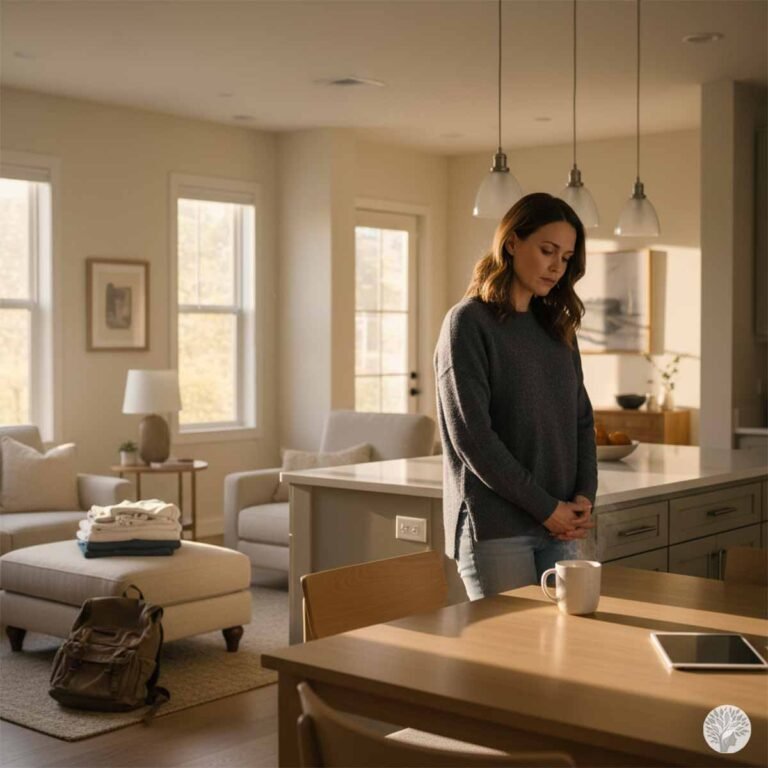
I remember a Tuesday evening last month when the house felt like it was shouting at me. It wasn’t just the television in the background or the usual sounds of a house in motion. It was the laundry basket overflowing near the hallway, a silent pile of chores I had ignored since Sunday. It was the pair of large sneakers belonging to my teenage son scattered across the entryway rug, a reminder of the rush he was in when he got home from practice. It was the stack of mail teetering on the edge of the kitchen island, a jagged tower of bills and flyers that felt like a physical weight on my chest.
To an outsider, it was just a lived-in home. To me, it was a high stakes list of demands I didn’t have the energy to meet.
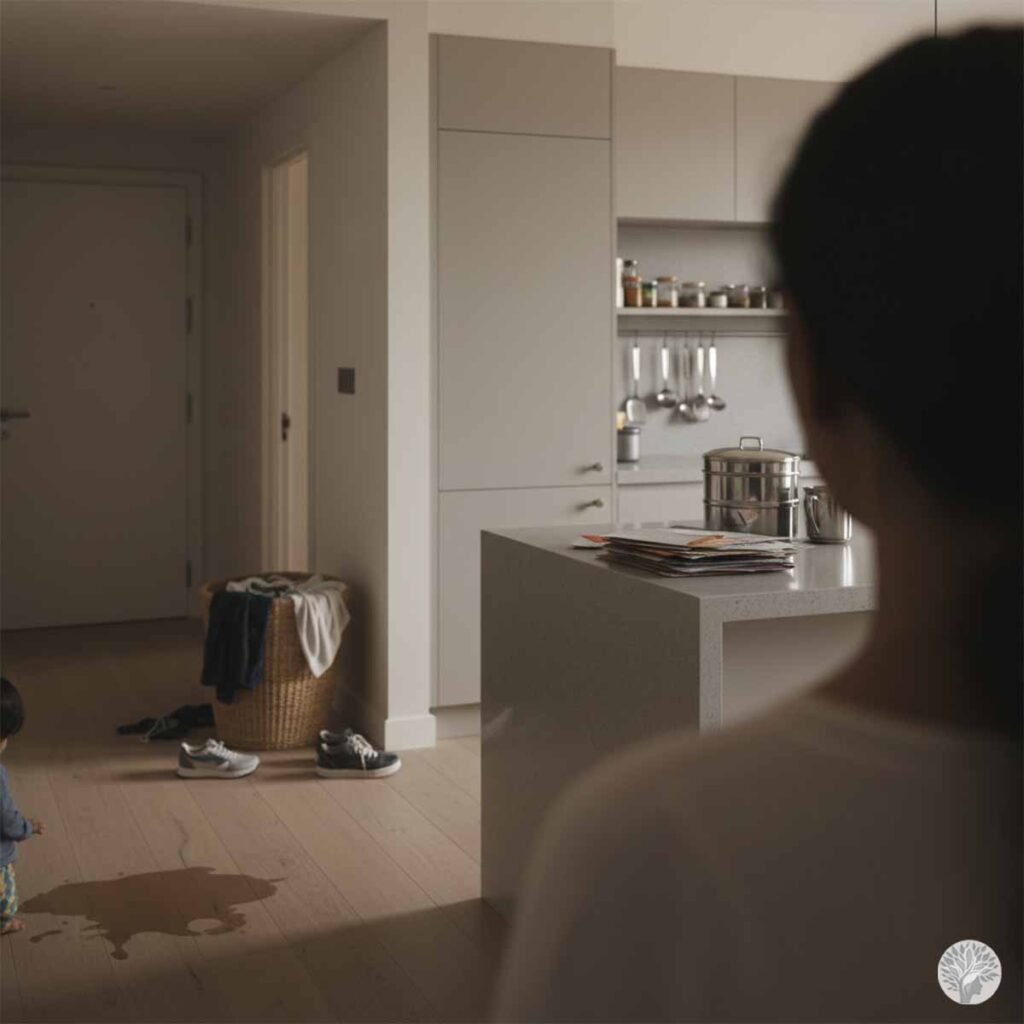
When a glass of water was accidentally spilled, the sound of the liquid hitting the floor felt like a thunderclap. I found myself snapping instantly, the sharp words leaving my mouth before I could even think. In that moment of silence that followed, I saw the confusion in his eyes. The water didn’t matter. The mess was small. But I realized then that my internal cup was already full. I wasn’t reacting to the spill. I was reacting to the noise of every unfinished task surrounding me.
That moment was a turning point. It was the first time I clearly understood that an overstimulated mom is rarely just tired of the noise from her child. She is tired of the noise from her environment.
I looked around the room and realized that every object out of place was a micro-task begging for my attention. My brain wasn’t seeing a shoe. It was seeing a requirement to put it away. It wasn’t seeing mail. It was seeing a demand to file, pay, or recycle. When you have a teenage son, that noise carries a different kind of weight. His presence is larger, his gear takes up more space, and his world is becoming more complex. The mental load of motherhood expands as they grow, and when our eyes have no place to rest, our bodies stay alert. We become trapped in a cycle of constant scanning. I wasn’t a mean mom or an angry mom. I was a mother whose nervous system had no place to land.
The Weight of the Unseen
We often talk about the mental load of motherhood as a list of visible chores. We talk about the pediatrician appointments, the school forms that need signing, and the never-ending cycle of grocery lists. But there is a silent, heavier part of that load that we rarely name. It is the weight of every object in our peripheral vision that isn’t where it belongs. This is the “unseen” labor of our eyes, and it is constantly draining our batteries.
You can feel this in your own body. Have you ever sat on the sofa to relax, only to find your heart rate won’t slow down? Your eyes are darting. They land on the stray sock under the chair, then shift to the half-empty glass on the side table, then move to the dusty shelf. Even though you are physically sitting still, your brain is micro-tracking every single one of these items. It is as if each object is a tiny, silent alarm clock ringing all at once.
When the room is cluttered, your mind simply cannot settle. You might be trying to have a real conversation with your teenage son or sitting down to enjoy a cup of tea, but your brain is stuck in a loop. It is busy calculating how long it will take to move that pile, where that missing charger went, and why the counter is still sticky. You are trying to be present, but your environment is pulling you back into “manager mode.”
This constant scanning is physically and mentally exhausting. It is the reason we feel utterly drained even on days when we haven’t “done” much in terms of heavy labor. Our brains have been working overtime just to filter out the chaos of our surroundings. This is the core of being an overstimulated mom. It is the exhaustion of a mind that has no place to rest because the eyes have no place to land.
Finding calm in motherhood often begins with creating a quieter, more supportive home environment. This isn’t about achieving a magazine-perfect life or pursuing a cold, clinical minimalism. It is about understanding that your peace of mind is directly tied to your line of sight. When you clear a surface, you aren’t just tidying a room. You are giving your nervous system a break. You are telling your brain that it can stop scanning for a moment. You are creating a visual “hush” that allows your heart to finally catch up with your body.
Why We Feel So Overwhelmed
Many of us are just trying to feel a little calmer at home. We live in a world that is constantly on, and our homes have become the last frontier of our peace. Yet, for a mother, the home is also the workplace. It is not just a building where we sleep. It is the cafeteria, the laundry, the infirmary, and the command center. For those of us raising a teenage son, it is also a hub of constant growth and changing energy.
When these boundaries blur, the calm home environment we crave disappears. We feel overstimulated because our brains cannot distinguish between a resting space and a working space when both are covered in the debris of a busy day. You might be standing in your kitchen, a place meant for nourishment, but your eyes are landing on a stack of school papers that need your signature and a pair of gym shoes that need to be moved. In that moment, your kitchen is no longer a place of rest. It is a workstation that is reminding you of everything you haven’t finished yet.
This is why so many of us feel a sense of motherhood and mental calm only when the house is finally still and the surfaces are clear. We feel we can only breathe when the “office” is closed. For years, I thought I was just a night owl, but I realized I was actually just waiting for the visual noise to stop. I was waiting for the moment when I was finally allowed to stop managing everyone and everything.
When your environment is constantly signaling “work” to your brain, your nervous system never fully enters a state of rest. You are essentially living in your office twenty four hours a day. By intentionally reducing overwhelm at home, we are trying to redraw those boundaries. We are trying to create “islands of peace” where the manager version of ourselves can finally clock out. This is a vital step in creating a calm home as a mother because it allows us to show up for our families with a full tank rather than a depleted one.
The Shift from Cleaning to Clearing
The most important thing I learned on this journey was the profound difference between cleaning and clearing. For years, I used these words as if they were the same thing, but they carry entirely different energies. Cleaning often feels like a heavy and demanding task. It is the deep labor that requires a vacuum, a spray bottle, and a significant block of your time. It is a commitment that many of us simply do not have the capacity for at the end of a long day. Clearing is different. Clearing is a small and accessible way to reduce overwhelm at home without needing a burst of physical energy.
Clearing is about removing the specific visual distractions that stop you from being present as a mom. It is the intentional act of creating space for your eyes to rest. It is about moving the stack of mail into a drawer so you can actually see the texture of the kitchen table. It is about tucking the tangled chargers into a box so you can see the natural wood grain of your desk. I found that hiding the tangled ‘digital noise’ of chargers into a Sleek Bamboo Cable Management Box instantly lowered my kitchen’s volume. It turns a workstation back into a sanctuary. When you clear a space, you are not just tidying a room. You are clearing a path for your thoughts to move freely. You are removing the roadblocks that keep your mind stuck in manager mode.
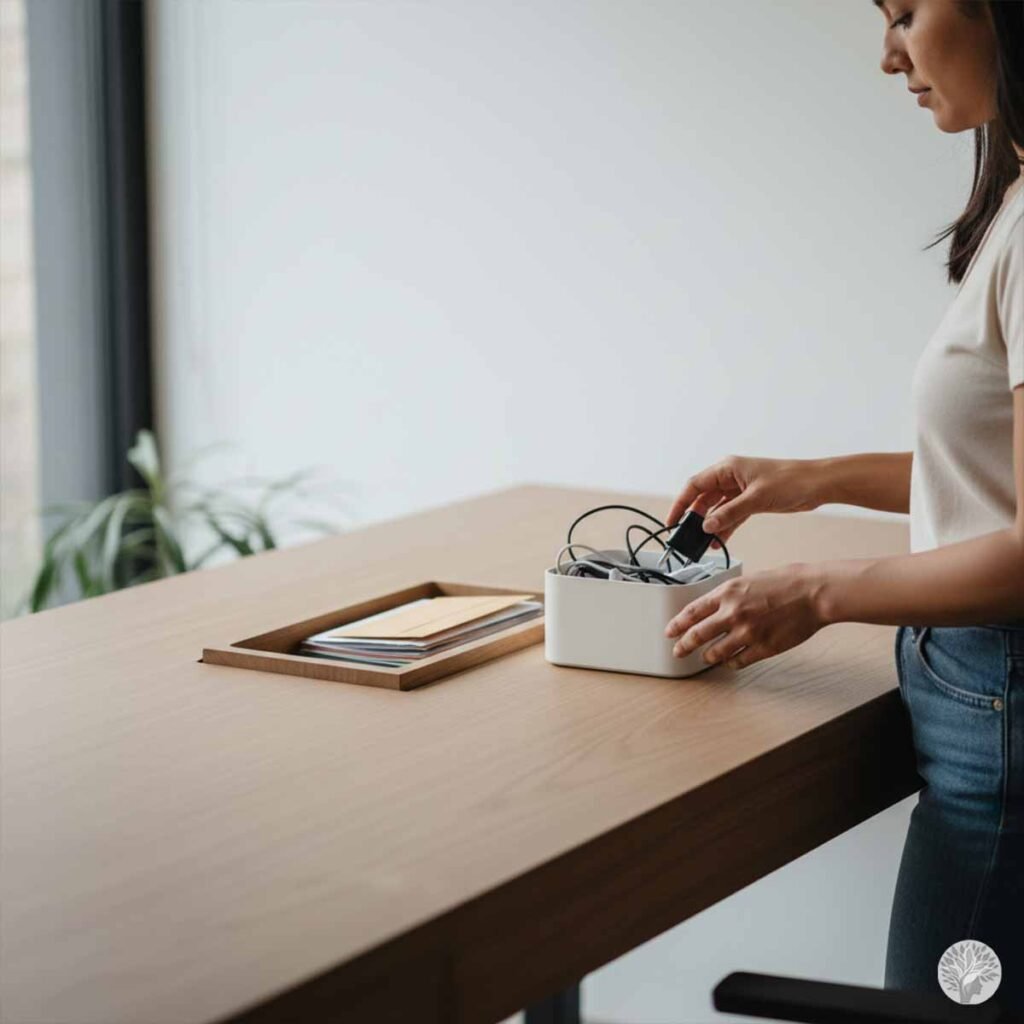
This shift in perspective was vital for me. I stopped waiting for the rare hour when I had the energy to deep clean the entire living room. Instead, I started looking for the sixty second windows where I could clear a single surface. I began to realize that a clean floor is nice, but a clear table is what actually allows me to sit down and breathe. Finding calm in motherhood became less about a sparkling house and more about a quiet house. By focusing on clearing, I was able to lower the volume of my environment enough to hear my own heart again. It allowed me to stop scanning for what was wrong and start noticing what was right.
| Feature | Cleaning (High Energy) | Clearing (Low Energy) |
| Goal | Sanitizing and Deep Organization | Reducing Visual Noise and Mental Load |
| Time | 30–60 Minutes | 60 Seconds |
| Result | A sparkling room | A quiet mind and a place for eyes to rest |
| Nervous System | Often adds to physical fatigue | Triggers an immediate “Neurological Reset” |
Small Resets for a Quiet Heart
If you are looking for how to feel calm in motherhood at home, you have to start with the smallest possible wins. One of the biggest mistakes we make is thinking that we need a total home makeover to feel better. We wait for a long weekend or a burst of inspiration to reorganize our entire lives, only to find that the daily clutter returns within forty eight hours. You do not need a perfect house to have a quiet heart. You simply need a few anchor points of peace that tell your nervous system it is okay to let go and stop managing for a while.
| Reset Type | Focus Area | Goal |
| The Entryway | Transition Zone | Stop the “outside world” at the door |
| Surface Sanctuary | Line of Sight | Create one spot for the eyes to rest |
| Catch-All Tray | Daily Static | Contain small, scattered distractions |
| Emotional Balance | Internal State | Move from reacting to responding |
The Entryway Transition

The entrance to your home should be a bridge that welcomes you, not a barrier that stresses you out. For many of us, the entryway is a high traffic zone of chaos where shoes are kicked off and bags are dropped the moment we walk through the door. When you walk into your house and immediately trip over a sneaker or have to sidestep a heavy backpack, your brain stays in that frantic and hurried energy of the outside world. It feels like you never truly arrived.
Taking sixty seconds to align the shoes and hang the bags up isn’t about being a perfectionist or having a magazine ready home. It is about creating a visual boundary between the chaos of the world and the sanctuary of your home. By straightening that one small area, you are signaling to yourself that you are here now. You are safe. You can finally put the weight down. It is a transition for your mind as much as it is for your body. Giving every bag a home in a Large Natural Seagrass Basket means I don’t trip over the ‘outside world’ the moment I walk in. It’s a sixty-second reset that changes my entire mood.
The Surface Sanctuary
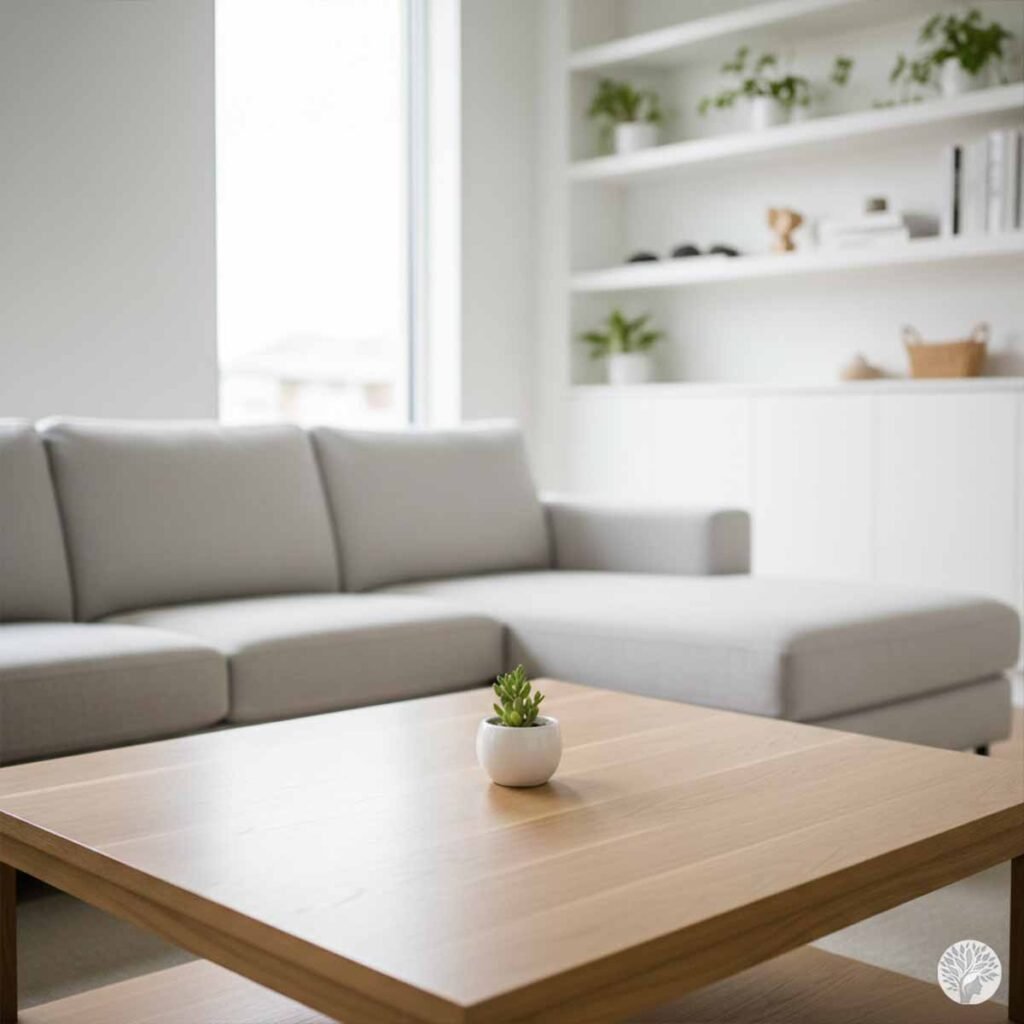
I found that the best way to reduce overwhelm at home is to pick one surface and declare it a sanctuary. Just one. Maybe it is your coffee table or the kitchen island where you sit for your morning tea. This becomes your “Visual Silence” zone.
You keep this space clear, not because you are trying to be a strict minimalist, but because your eyes need a place to land that doesn’t ask them for a favor. When your surfaces are covered in chargers and mail, they are constantly asking your brain to make decisions. A clear space asks nothing of you. When you look at that one clear table, it reminds you that you are in control of your environment rather than being at the mercy of it. It serves as a visual deep breath in the middle of a busy day.
The Use Of A Catch All Tray
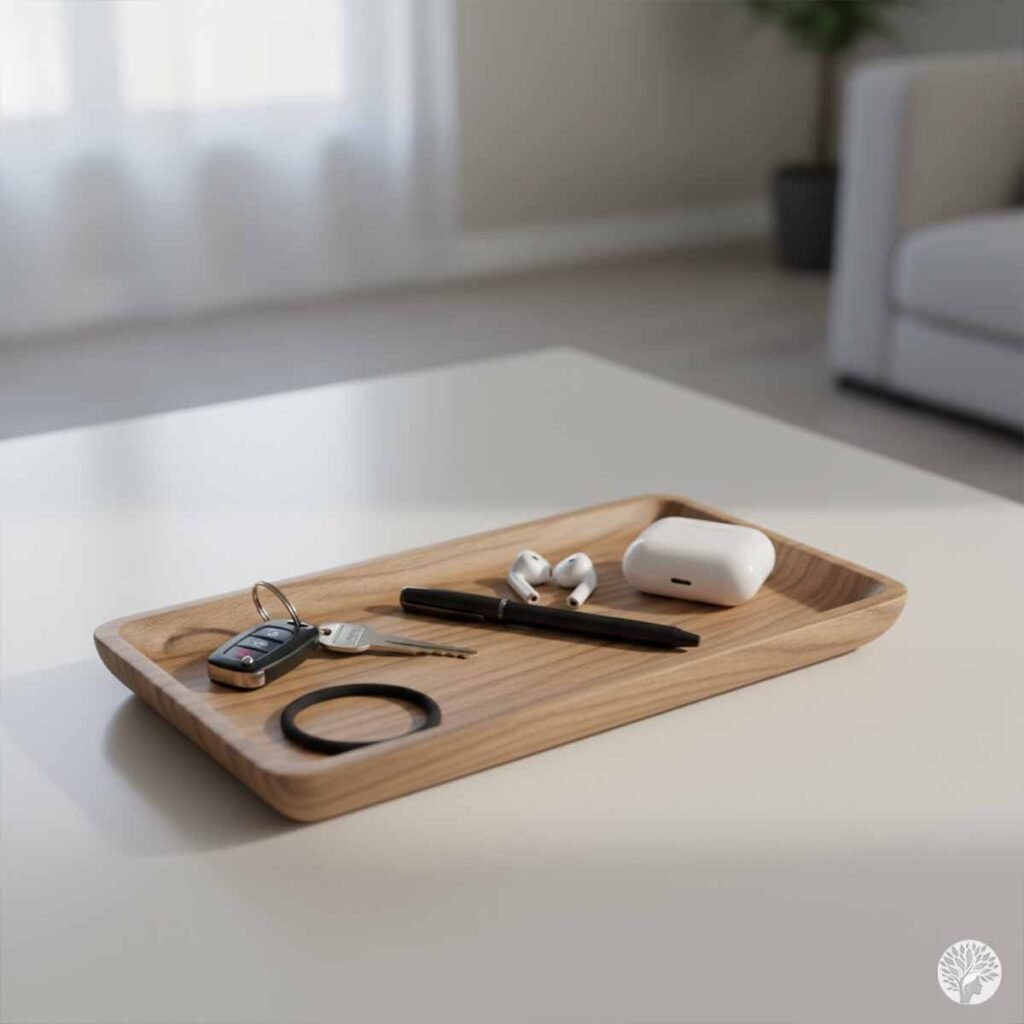
We often feel the mental load of motherhood spike when we see dozens of small and random items scattered across the house. A set of keys on the counter, a pair of earphones on the sofa, a stray pen on the desk. Individually, these things are small. Collectively, they create a loud static that our brains have to work hard to ignore.
Instead of trying to find a permanent home for every single tiny object in the middle of the day, use a simple wooden tray. A tray acts as a physical boundary. it gathers all that “noise” into one intentional spot. One tray filled with items is much easier for your brain to process than ten items scattered randomly across a room. It gives the clutter a home so it stops cluttering your mind. By containing the chaos, you are creating a calm home as a mother one small tray at a time. I started using a Deep Walnut Wooden Tray to catch the keys, earphones, and pens. It gathers the static of the day into one intentional spot so my eyes can finally rest.
Finding Emotional Balance
Creating a calm home as a mother is not a luxury or a hobby. It is a profound act of emotional preservation. We often feel guilty for wanting things to be “just so,” as if our need for order is a sign of being high maintenance or overly controlling. In reality, we are protecting our ability to be kind. We are protecting our ability to be patient and present. When we reduce overwhelm in our physical environment, we are literally creating the mental and emotional space required to breathe through the hard moments that every day brings.
I have realized that finding calm in motherhood is not a final destination we reach once the house is perfectly curated. It is a daily and often hourly choice to stop the “doing” and start the “being.” It is the moment you decide that a kitchen sink being “light” is far better for your soul than a kitchen being perfect. Perfection is a demanding boss that never gives you a day off. Peace is a friend that tells you that you have done enough.
Choosing this balance means giving yourself permission to ignore the one stray item on the floor because the rest of the room is quiet enough to allow your mind to rest. It is about recognizing that your son needs a mother who is calm and connected more than he needs a mother who is busy polishing every surface.
When you prioritize your emotional balance, you are changing the entire climate of your home. You are shifting from a reactive state where every mess is a crisis to an intentional state where you have the bandwidth to handle the real challenges of raising a teenager. By creating a calm home as a mother, you are building a sanctuary where you can finally step out of your role as the manager and step into your role as the heart of the family. You are making room for the laughter, the deep conversations, and the quiet moments of connection that clutter often crowds out.
The Power of the Final Ritual
The day eventually ends. The constant motion of a busy home slows down, and the chores are finally paused. This is a sacred moment that every mother knows, but we often spend it catching up on even more work. Instead, this should be the moment to close the day officially and intentionally. It is not about a deep clean or a massive overhaul. It is about a simple set of actions that tell your brain that the “office” is closed and the manager is off duty.
Dim the lights to soften the edges of the room. Clear the last mug from the side table. Put the pillows back in their places on the sofa. This is simply the sign that the day is done.
When the surfaces are clear and the visual noise has been lowered, you don’t have to try to relax. You just do. Your body recognizes the silence of the room and responds in kind. You are not scanning the space for the next task anymore. You are finally sitting in it. You are not thinking about what needs to be done tomorrow or what was left unfinished today. You are present for the actual moment you are in.
Lighting a candle in that quiet and cleared space is the final anchor of the evening. It is more than just a pleasant scent. It is the sensory sight of stillness. As the flame flickers, it marks the transition from the “doing” of motherhood to the “being” of yourself. It is a small but powerful way of creating a calm home as a mother because it rewards your efforts with immediate, sensory peace.
Finding calm in motherhood often begins with creating a quieter and more supportive home environment. It is the profound realization that clearing the table was never really about being neat or following a set of rules. It was always about making room to breathe. It was about reclaiming your own mind from the clutter of the day.
Start small. Clear one thing. Feel the difference.
Stay mindful of the space you keep, because a quiet home is the gentlest way to quiet the mind.
Love ya, stay mindful!

© 2026 The Mindful Mom Life. All rights reserved. This methodology is part of the Hetal Method helping mothers find neurological rest through intentional home management. No part of this work may be shared or reproduced without credit to the original source.
Find Your Next Pocket of Calm
- How to Stop Being a “Reactive” Parent – 5 Simple Mindfulness Practices for the Midday Overwhelm
- Simple Living Tips For Busy Moms
- Motherhood as a Practice of Letting Go
- Holistic Self-Care for Moms in 2026: Small Rituals That Restore an Overwhelmed Nervous System
- Best Meditation Tools for Moms in 2026: Accessories That Calm an Overwhelmed Nervous System